
Hyundai’s ground-breaking i30 N spawned a whole new performance brand and it quickly developed a huge following. There are many reasons for that – the original N was an absolute belter, Hyundai has invested heavily in its enthusiast fan-base and backed it up with WRC participation with the i20. It had pedigree before it even got off the ground with the hiring of Albert Biermann from BMW M.
So when news broke that the equally ground-breaking Ioniq 5 electric…hatchback?…was going full-fat N, the internet set itself ablaze. There was the usual “EVs can’t be fun” nonsense (you know who you are and you’re not going to come off particularly well in this review) but fortunately for us, Hyundai threw an enormous amount of money and talent at the N.
It’s quite a thoughtful thing – there are some deviously clever ideas that could go terribly wrong. The transition to N could might ruin the Delta Integrale vibe. It could have come off as a kind of electric (base) GT-R – fast, but you’d just be hanging on. It might not be enough to silence the critics.
Let’s find out. I drove this a long, long time after it arrived and that was entirely my fault. Hyundai bore with me after booking it about five times only to have to cancel the booking due to work commitments. That’s a long time to avoid consuming to much media about it so it was a huge relief to finally get it in my grubby hands along with co-pilots Mark and Blake.
How much is a Hyundai Ioniq 5 N and what do I get?
Hyundai Ioniq 5 N: $117,337.70 + ORC
At the moment you get one specification of 5 N, weighing in at just under 110 large before on-roads. Cheekily, Hyundai has separated the luxury car tax from that price, so we’ve helpfully added it for you where the website has not.
I have no truck with LCT separation in headline prices any more than I do with online shops who separate GST. You have to pay it, there’s no way around it.
(I have no problem with you knowing about this obsolete tax and how much it is, but you surely must see my point)(also, tax $20,000 handbags and watches and stuff if you’re going to tax luxury items, it’s incredibly stupid not to)(end of rant)
Your money buys you 21-inch forged alloys, dual 12.3-inch displays (running ccNC, Hyundai’s media and entertainment system), black leather/Alcantara interior, wireless CarPlay and Android Auto, heated and ventilated front seats, wireless phone charging, V2L power supply, keyless entry and start, sat nav, eight-speaker Bose-branded audio, head-up display, dual-zone climate control, auto LED headlights, remote control parking via key fob (forward and reverse only), powered tailgate and a tyre repair kit.
There’s a lot more, obviously, but that’s all in the chassis and drivetrain.
Safety
The Ioniq 5 ships with six airbags, forward AEB, junction assist, lane keep assist, blind spot monitoring, lane change assist, driver attention warning, evasive steering assist, adaptive cruise with lane following, intelligent speed assist, safe exit, reverse AEB and cross-traffic alert and rear occupant warning.
The Ioniq 5 scored five ANCAP stars in 2021, a rating that will expire in 2027.
Look and feel
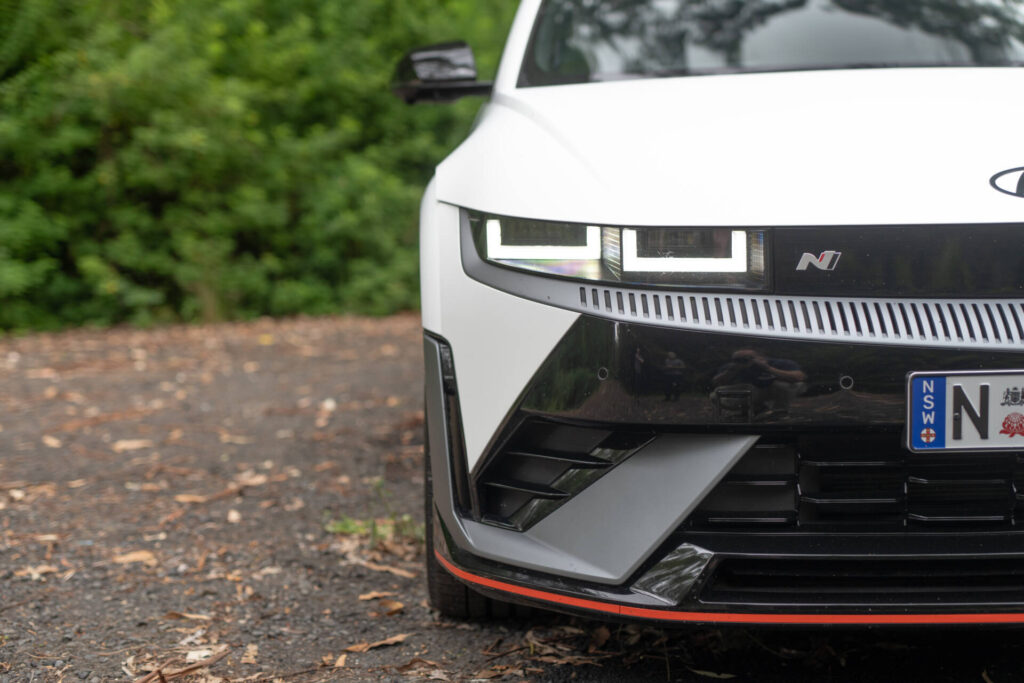
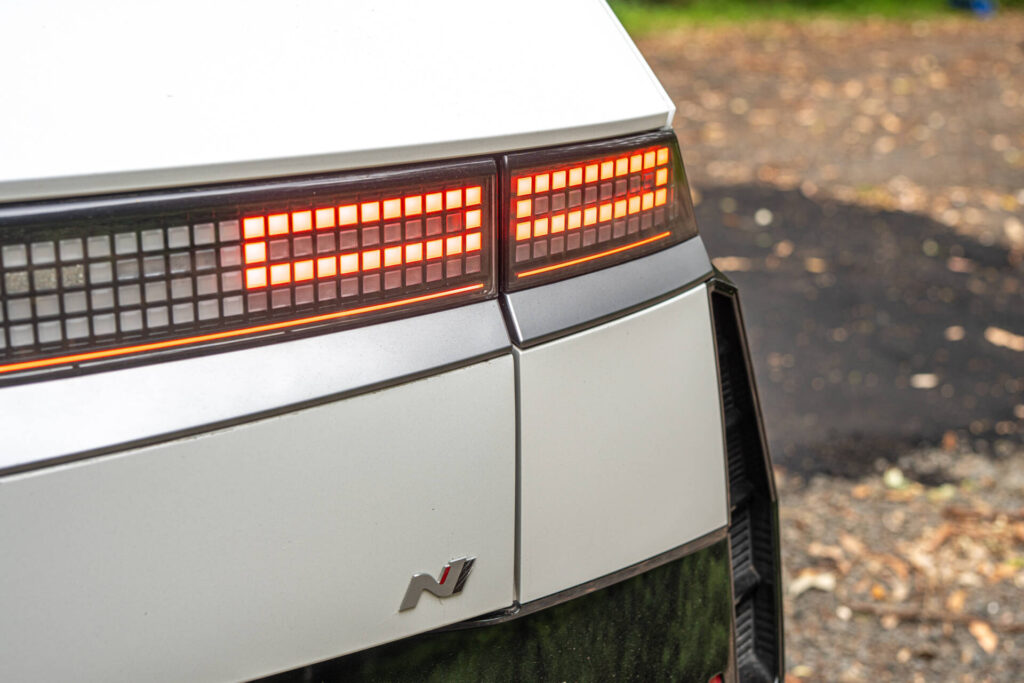
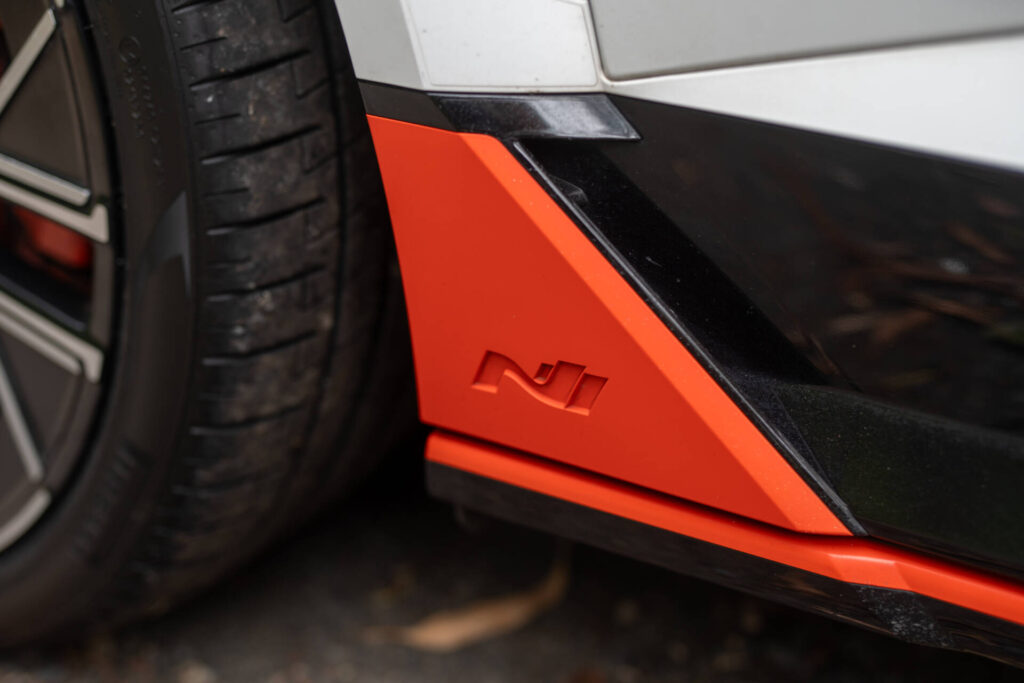
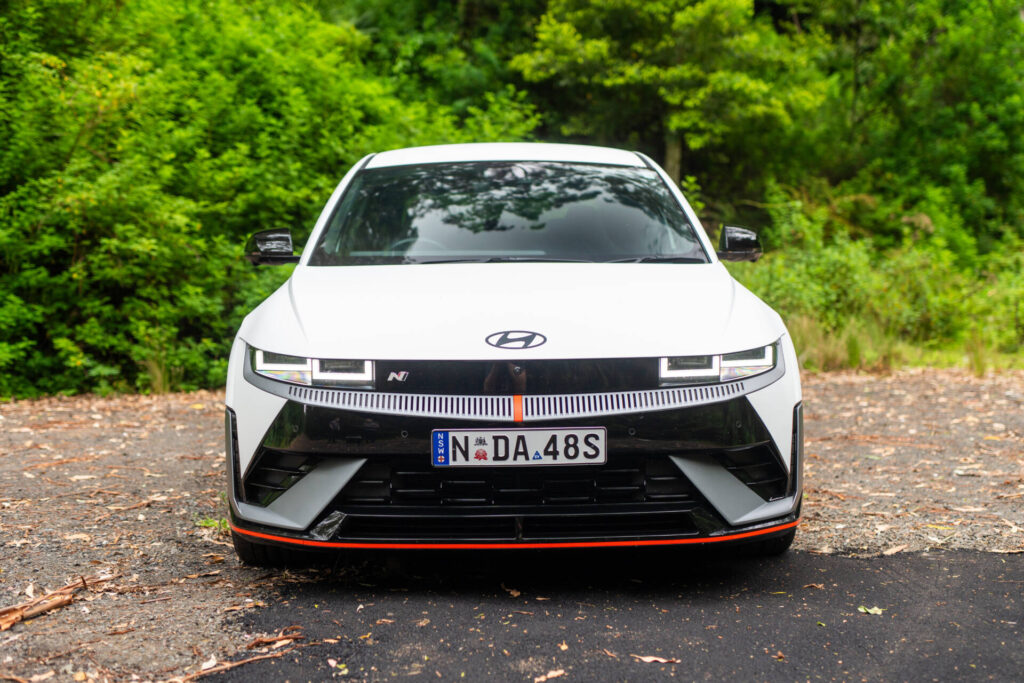
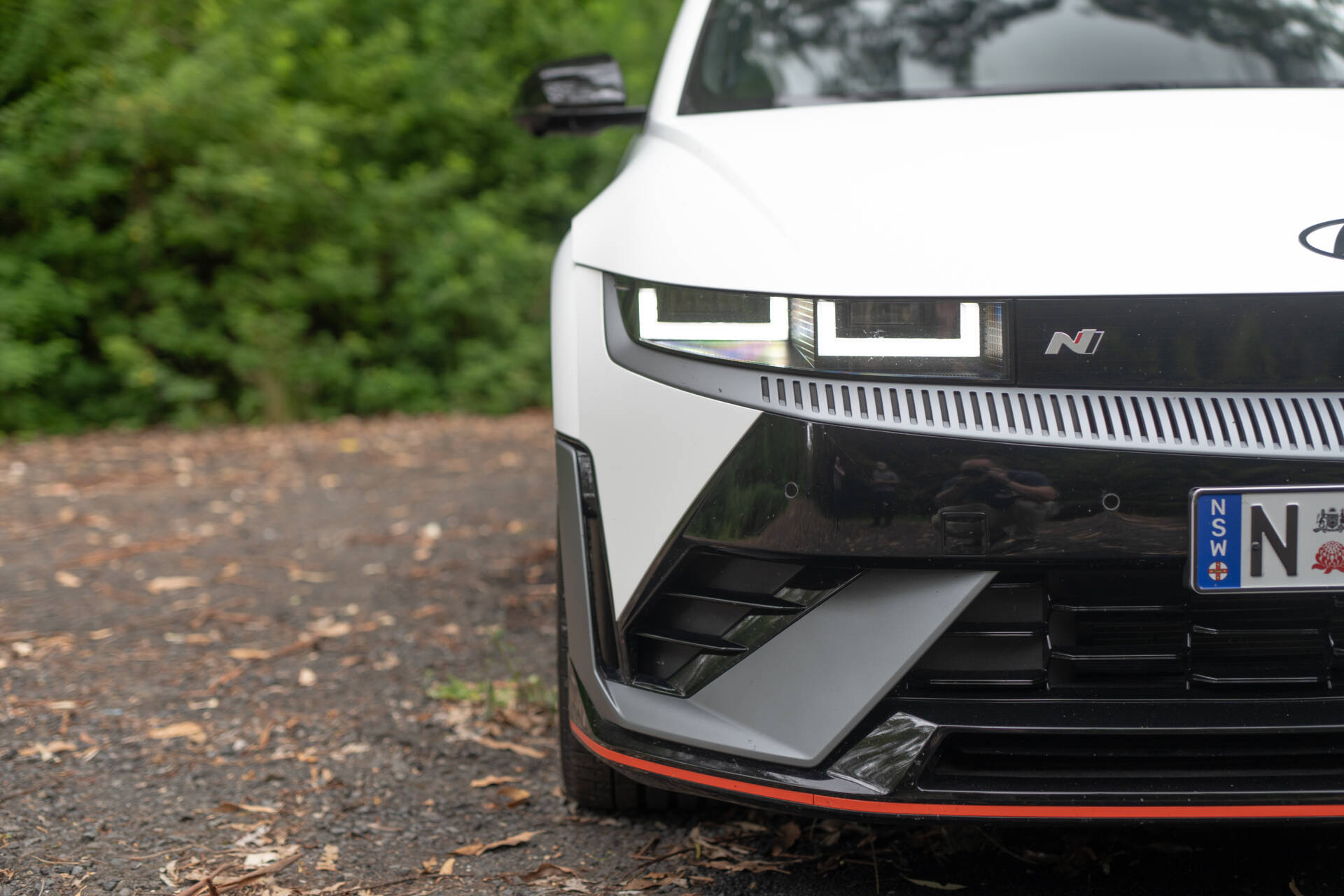
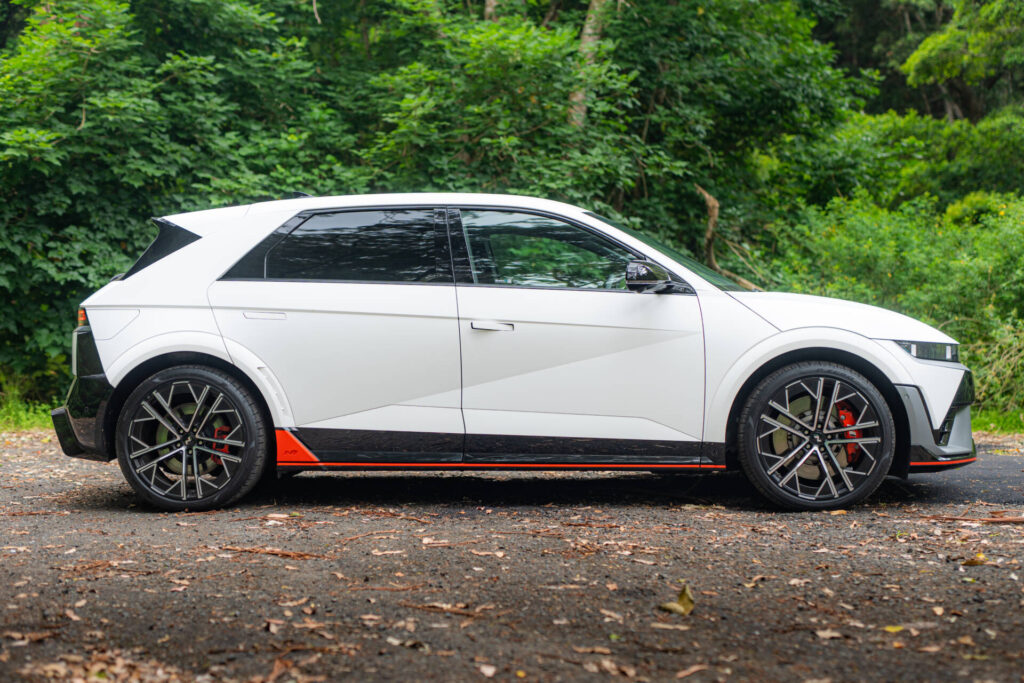
Instantly I was drawn to the Ioniq 5 by its Lancia Delta Integrale shape. It’s an incredibly good-looking car and I love the pixel detailing in the lighting. The shape also makes it look remarkably smaller than it is at 4.715m long.
That’s not a small car while the Lancia was, at just under four metres. I’m not certain that was the stylistic point designer Lee Sang Yup was trying to make (under the watchful eye of Luc Donckerwolke), but Hyundai says it was heavily influenced by Giorgetto Giugiaro’s Pony concept from 1973.
Have a guess who also designed the Lancia Delta? Go on, you’ll nev- okay it was Giorgetto Giugiaro.
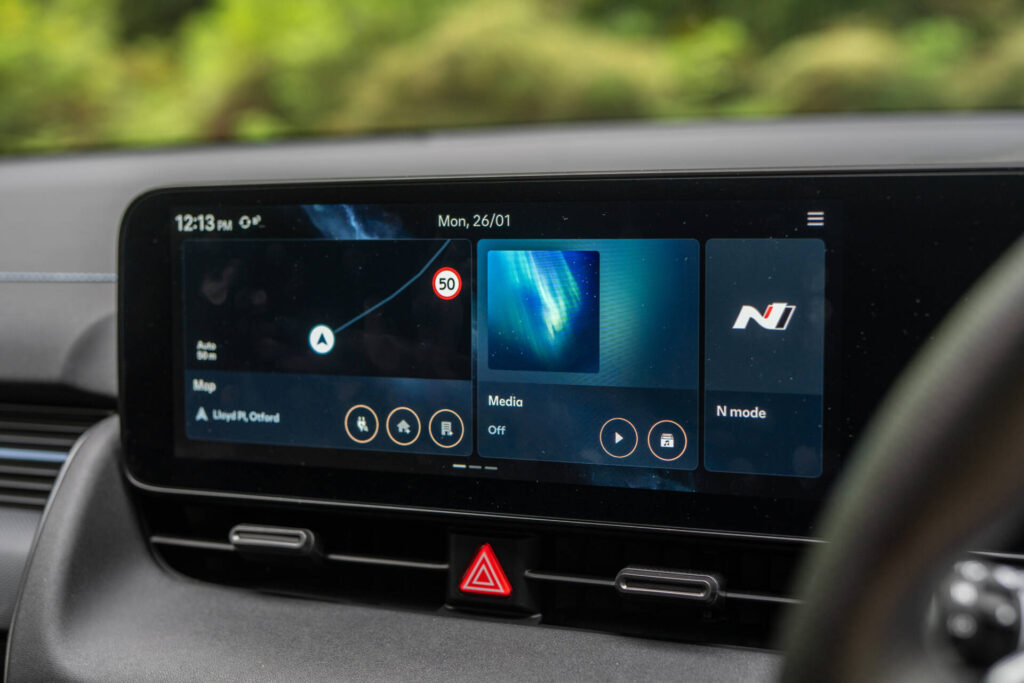
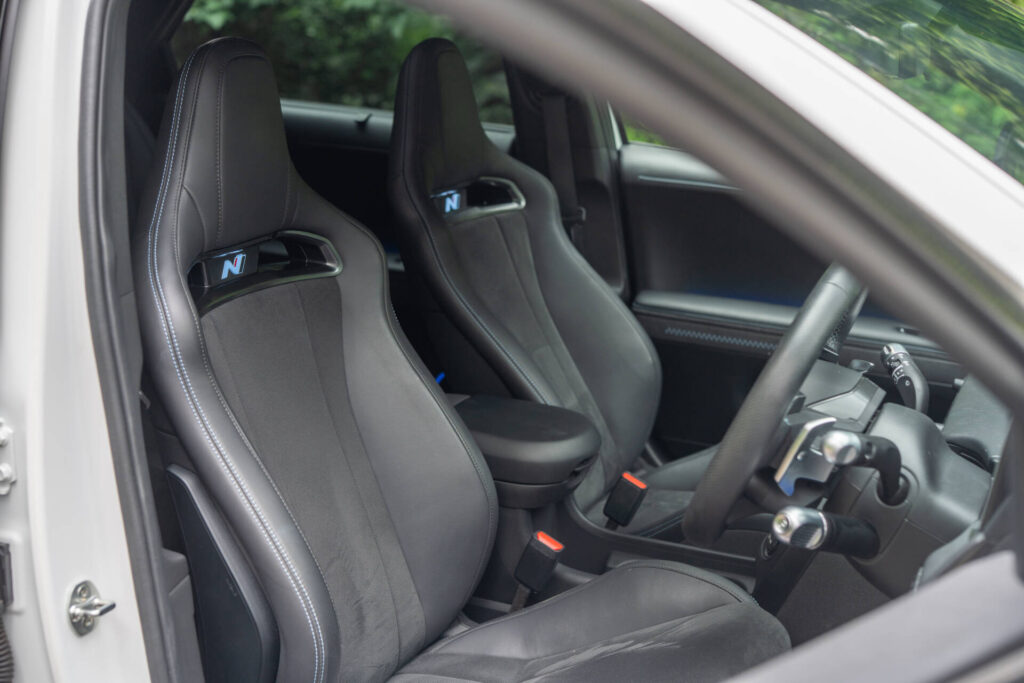
The cabin doesn’t quite fit with the crisp exterior, but it never really has. The N debuted the updated Ioniq 5 interior with the new screen layout, which is certainly more in keeping with its high-tech vibe.
Obviously I’m not saying it’s a bad interior, because it most certainly is not, it’s just a bit softer to look at than the exterior. The materials are pretty good and those front seats are super comfortable while also holding you in.
I quite like the update to the centre console, too, which apparently shaved a bit of weight.
But it’s all set off by those chunky seats which put you in the right place and don’t feel at all high. They’re manual, which is a bit weird at this price point, but it didn’t bother me one jot.
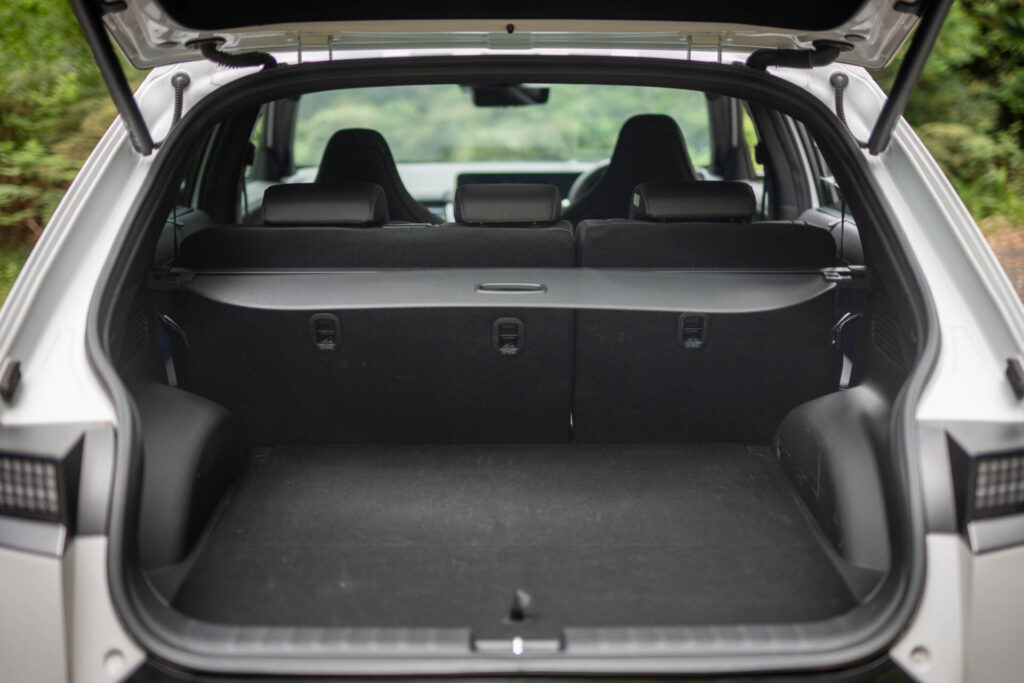
Otherwise, it’s very roomy and comfortable front and rear, with plenty of space for four adults, five if the fifth was moderately slight. Headroom is good and even the boot is a good size, especially for an EV with a whopper of a battery.
Chassis
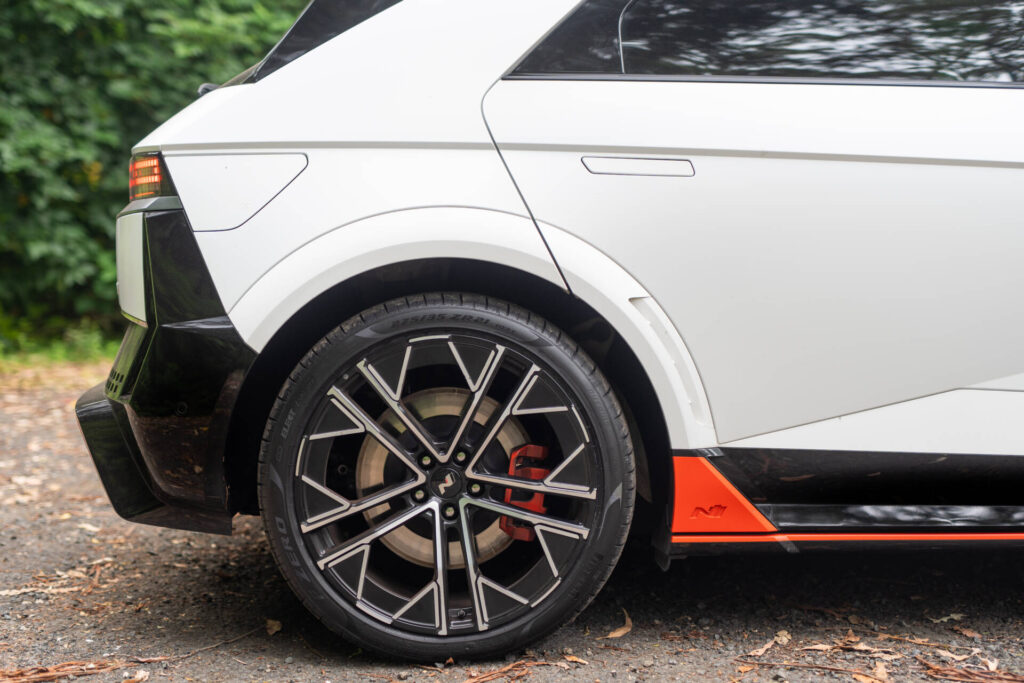
Right out at each corner are 21-inch forged alloys wrapped in 275/35 R21 Pirelli P-Zero tyres, obviously with Hyundai stamping. Braking comes courtesy of massive 400mm front rotors and 360mm at the rear, with the fronts gripped by four-piston calipers. They don’t look 400mm behind those huge wheels.
There is a bunch of software toys largely focussed on the track. You can configure left-foot braking or one-pedal braking meant to emulate “a pro driver”, there’s a drift optimiser and, of course, launch control. As if it needs it.
The media screen also has a whole bunch of stored tracks to help you find your way around as well as track-compliant timing gear that talks to trackside transponders, same as the i30 N.
It’s worth pointing out that by its very nature, the 5 N is rear-biased all-wheel drive because the more powerful motor is at the rear.
On top of all of that is the fake gear shifting. I think I worked out how they did it and it’s genuine genius.
Adaptive damping is along for the ride and it’s all configurable against the dual N buttons on the steering wheel, which behave the same way as BMW’s programmable M buttons or Audi’s RS counterpart.
The damping is attached to the tried and true struts at the front and a multi-link rear end.
Drivetrain
Power: 478kW combined
Torque: 770Nm
0-100km/h: 3.4 seconds
As it’s an EV, the headline numbers aren’t as straightforward as they look, so we need a table.
| Normal | N Grin Boost | |
| Front motor power | 166kW | 175kW |
| Front motor torque | 350Nm | 370Nm |
| Rear motor power | 282kW | 308Nm |
| Rear motor torque | 390Nm | 400Nm |
| Total power | 448kW | 478kW |
| Total torque | 740Nm | 770Nm |
Whichever way you cut it and despite its 2300kg-ish kerb weight, that’s a crap ton of power to shift the Ioniq 5. The great thing about an EV is that it can be as docile as its Inster stablemate or as completely mental as, well, something with this kind of grunt.
N Grin Shift is obviously not always in charge, but it’s still mega quick without it switched on.
As you can see from the table, there’s a front motor with 166kW/175kW and 350/270Nm while the rears are juiced up to 282kW/303kW and 390Nm/400Nm. For the keen motor nerds among us, they’re permanent magnet synchronous motors (PMSM).
Battery and charging
Size: 84kWh (80kW usable)
Chemistry: NMC
Architecture: 800V
A hefty slice of the 2.3-tonne kerb weight is the 84kWh battery. Built with Hyundai’s 800-volt architecture, you can theoretically charge at up to 350kW for a 10-80 percent charge of 18 mins. You won’t always get that but battery pre-conditioning will give you a better chance by heating or cooling the battery as needed.
At more modest speeds, set yourself an hour or so for a 10-80 percent charge which will deliver around 300km of range. The price of all this power is, if course, a faster battery drain but really, few cars with this kind of performance won’t run out of petrol before the Ioniq 5 N. You can’t say that very often.
Driving
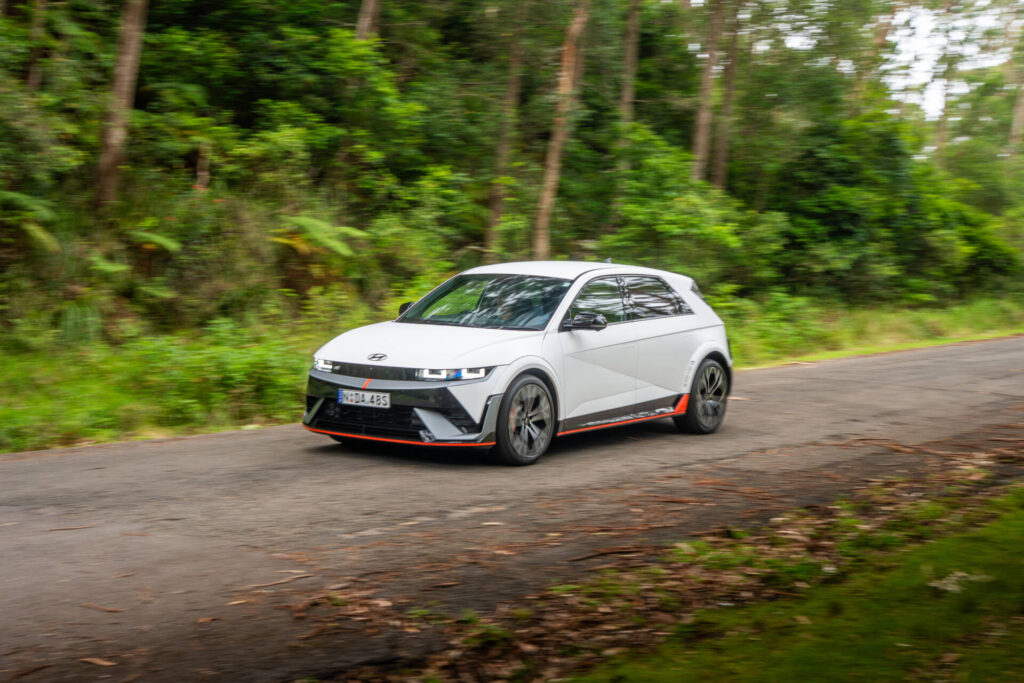
I had been anticipating driving one of these for a long time. Frustratingly, I had booked it several times only to have other, more pressing matters intervene, such as earning actual money to live on. None of it was Hyundai’s fault.
The problem with waiting so long is kind of like being the last person to see that movie or that TV series. You want to form your own view and have to ignore the coverage. Wheels Car of the Year sort of blew the top off of that, but you know, I wanted to have a baggage-free review.
Having driven a few “normal” Ioniq 5s, I had high hopes. Also knowing that this was Albert Biermann’s first start-to-finish N car further heightened these hopes. And the broader Hyundai EV range is so good, even the Inster is a cracker.
As I’ve already said, the front seats are really comfortable. Properly low in the car, you feel like you’re in a sports car already while also having the added advantage of keeping your own weight down in the car. Probably less of a deal when you’ve got a slab of battery underneath you, but every little bit counts.
You are not, however, Toyota 86 low, heck you’re not even i20 low. That is the nature of the beast.
The steering wheel is about as perfectly-sized as you could hope, with an appropriately chunky rim, but not so chunky that it’s difficult to manipulate.
Everything is fairly straightforward to operate, everything is where it should be apart from the annoying shifter which I just don’t like, there’s nothing functionally wrong with it.
Startup is accompanied with a bit of whizz-bangery from the dual screens and the slightly daggy selector stalk is the same as any other Ioniq 5. The N, of course, is festooned with extra buttons and modes.
Normal driving is super-normal. With everything turned down, it’s quiet and comfortable even on the big boy wheels and tyres and you can feel that it hasn’t suffered anything bad on its way to supercar-fast status.
Straight away, it proves you can throw wild performance at a car and make it as civilised as you like if you get the software right.
Turning it up to N mode and sticking in the boot in also proves that getting the software right means you can give an electric car the personality of an absolute lunatic.
(I’d love to compare it to a Porsche Taycan but I think I’m the sole motoring journalist on the planet not to have driven it).
Even leaving it in what you might term is a fast road setup (ie one that won’t invalidate your insurance should the unthinkable happen), the Ioniq 5 is hilariously fun.
Point to point, this would be an extremely difficult car to to beat with a combustion engine. You may stay with it if you’re lighter, particularly if you’re light, but it will have you eating tarmac once it’s past the apex.
The colossal thrust out of the corners gets more and more brutal the further up the levels of ferocity you choose.
But, as we know, anyone can bash out an EV that goes fast in a straight line. The doofuses at Tesla can do it, the still-working-it-out folks at MG and BYD can do the same. The MG IM5 is mind-bendingly fast in a straight line but hasn’t got anything like the finesse needed to be genuinely fun.
Volvo went and jacked up the EX30 dual motor variant when it should have made it lower and stiffer and even more responsive than the single motor.
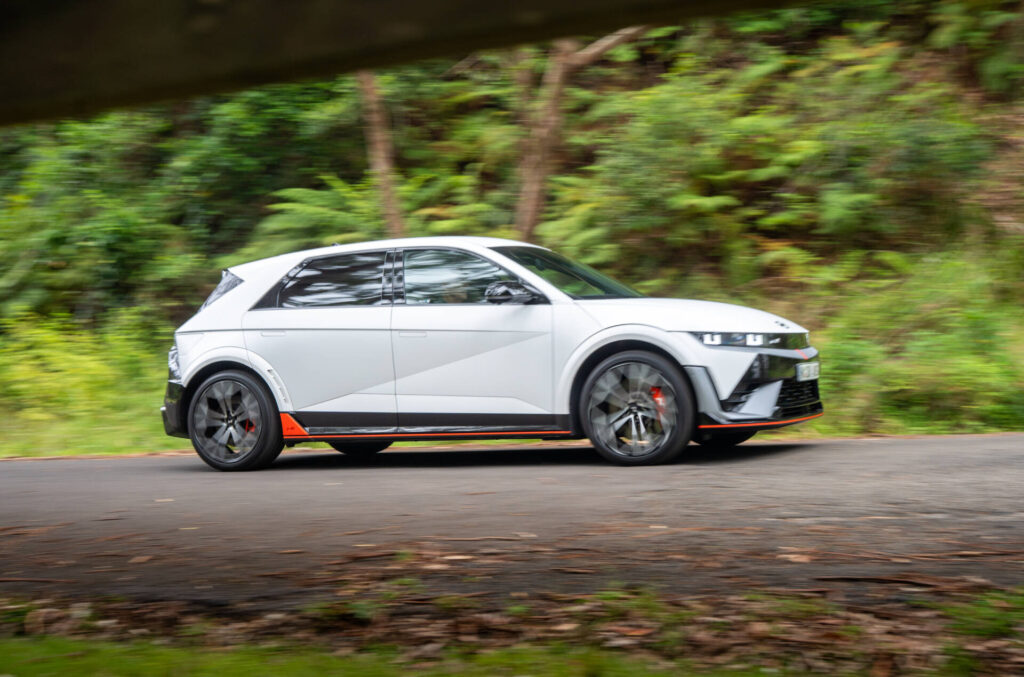
So this is where the Ioniq 5 really knocked me out of the park. It is so much fun to drive and is as much fun as any other N car I’ve driven. The steering has more feel than a car this heavy has any right to (not pretending we’re in Lotus hydraulic steering territory here, but it’s all relative), meaning you can fire this two-tonne plus car into corners with precision and confidence.
The front end darts for the corners in a way that suggests a ton of work has gone into simulating active diffs as pioneered by Biermann’s M division. My favourite bit of road was exhilarating in a way I had not yet experienced in an EV.
It handles surface changes with a shrug of the shoulders and, if you’re going quickly enough, a wag of the tail. The actively damped suspension lives with pretty much anything you can throw at it and does so quietly, so you won’t be asking yourself if you’ve whacked the stops.
Big bumps don’t really figure in your thinking and on this road there are some absolute bombs hidden in the shadows and if you don’t know they’re there, you’d get a huge fright in plenty of cars with this kind of performance.
Body control is sensational for such a heavy car on big wheels, too.
And of course, with all this weight, the brakes have to be up to it and they are. It never felt like it wasn’t going to stop and they’re easy to modulate. The regen braking can be switched off but even when it’s on, the transition is near faultless.
Switch to “manual” mode and it opens up a whole new avenue for fun. I love the way this works, using the regen paddles as gear shifters, a hilariously overblown soundtrack piped into the car to sound like an engine.
It could have been a dumb gimmick, but manages to be the perfect bridge for the folks who think they don’t like EVs. You can bring the muscle memory of a twin-clutch or automatic sports car with you, complete with left-foot braking setup, and have an absolute blast.
But whichever mode you’re in, standing start or in-gear acceleration at legal road speeds is brutal. You’ll be pinned to your seat whether you’re stepping off at rest or gunning down a slow-moving truck.
When you’re on it, the way it launches out of corners will never get old, the massive thrust carries you away. But, critically, it never feels like it’s going to get away from you.
A lot of those quick EVs start to float a bit as speed increases between corners, acting as a sort of involuntary brake. I always found myself lifting off in the IM5 and Seal Performance because it felt as though there was a heap of front lift. You could keep the 5 N’s throttle pinned because it never felt like that.
And that’s before we get into track modes and drift modes, which I obviously didn’t try out because I’m not an idiot and didn’t have the right places to do it. If the opportunity ever arises, however…
And it would be remiss of me to fail to mention that this car has seen things and done things and was still tight as a drum. It’s been on Hyundai’s fleet for a long time and has been thrashed to within an inch of its life but still absolutely hammers along.
The co-pilots’ view
Blake Currall:
“The car that would turn any EV sceptic into a believer. An unbelievable laugh, sharp handling, immense power and standard Hyundai comfort and ergonomics.”
Mark Dewar:
“I was keen to sample the Ioniq 5 N and specifically the simulated sound set up. I was both surprised and impressed that it could mimic the i30N in both noise and driving characteristics. I had to engage in paddle shifting as well. Full virtual i30N. Great but not near as good as the go from 0-60kmh and the refined one pedal driving. So, I turned the simulation off.
It looks good in white too.”
Redline Recommendation
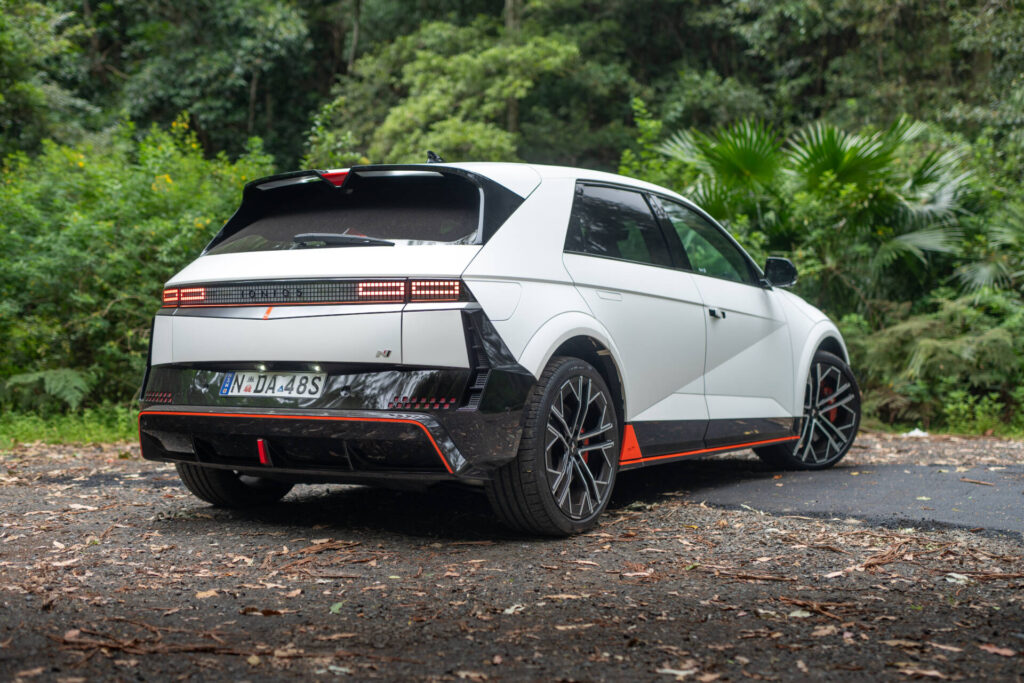
I was chatting to a friend whose whole vibe is, “If it ain’t a petrol six, I’m not interested” and he said EVs have no soul. And he’s right, a lot of them don’t, but neither did 90 percent of mass-produced sixes, let alone the rest of the car market. He didn’t have a ride in the Ioniq 5 N, but one day he will and it might change his mind.
Is the Ioniq 5 N effortless? No, and nor should it be when you’re out for a laugh. You want a car to challenge you and the 5 N does and not just because the distance between corners feels shorter.
The first time I drove a Ferrari f12 berlinetta, I was less worried about the lack of a manual because good grief, it’s all happening so fast. A lot of armchair critics think EVs don’t have anything to offer people like us but Hyundai proves they do.
It takes a lot of will and the bravery of a company like Hyundai which continues to be one of the most interesting car companies on the planet. They might make a lot of boring SUVs like everyone else but time and again kick out a thing like the Ioniq 5 N to change your mind.
N changed the hot hatch world forever with the i30 and has changed the EV world with the 5 N. The 6 N…well, we’ll soon see..

Leave a Reply