
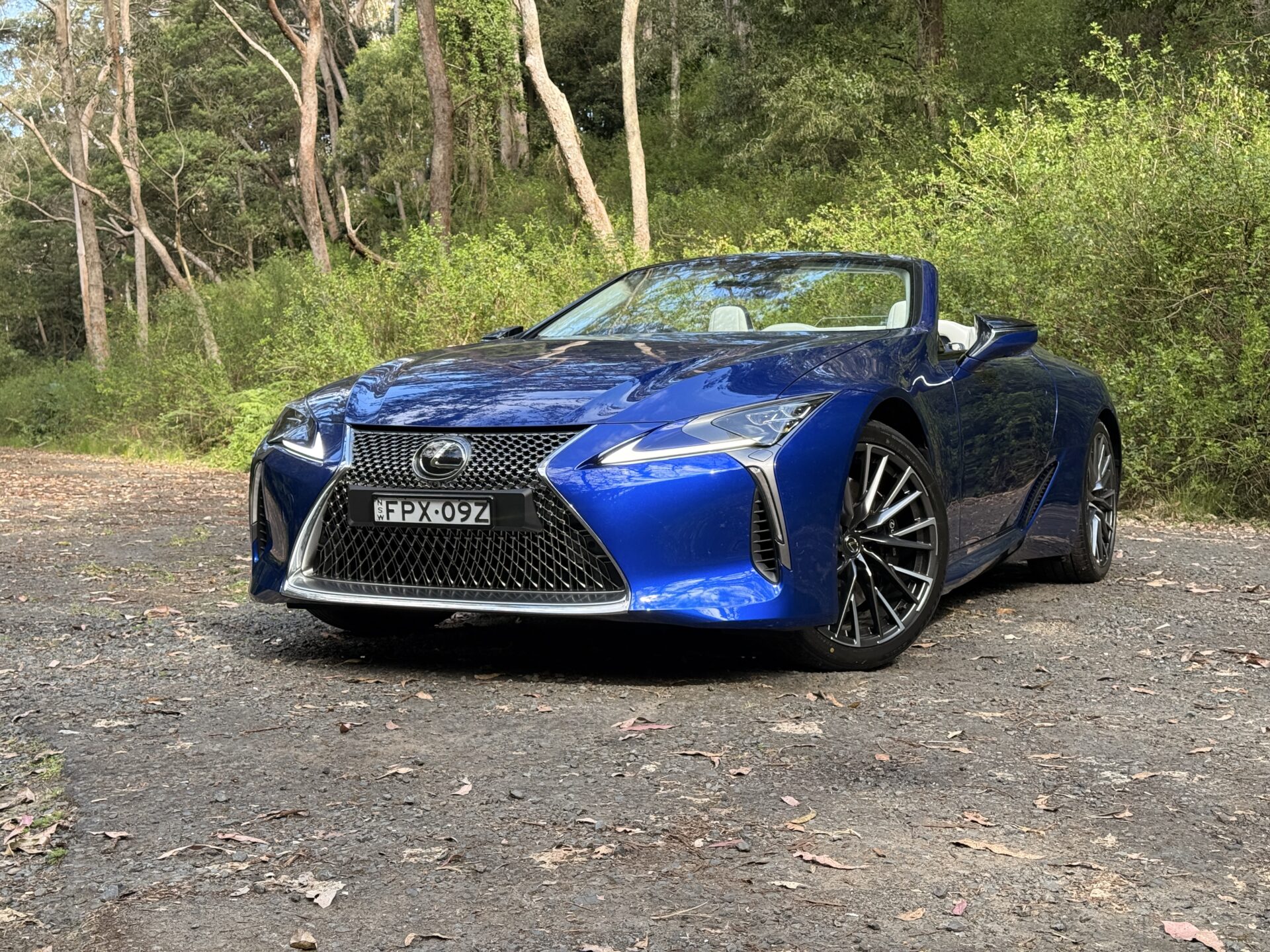
In what is probably the last drive we’ll ever have of Lexus’ sublime, V8-powered luxury coupe, the LC500, Peter Anderson enjoys the version of the car he’d never buy a little bit more than he thought he would.
Words: Peter Anderson
Co-pilot: Mark Dewar
Images: also Peter Anderson. Can’t you tell?
I have loved the Lexus LC500 since the moment I clapped eyes on it. I reckon it’s the most dramatic-looking car on sale today. Elegant, pretty and striking all at once, it genuinely harks back to a time when sports cars were genuinely gorgeous.
I love it from the huge spindle grille to exhaust tip. I’d be the kind of dumb rich guy who would buy one to park up a wall in my house. No, really, I love it that much.
This final drive before it quietly moves off the forecourts at Lexus after a long innings is tinged with great sadness.
For a start, it has the sublime 5.0-litre V8 that has appeared in so many excellent Lexuses over the years, from the original IS F, the GS F and the RC F. My wife, who is not exactly a hot-rodder, almost begged me to find a way to own the IS F because she loved the engine so much.
Smooth and incredibly powerful, it is distinctive in its revvy smoothness. But I’m getting ahead of myself.
How much is a Lexus LC500 Convertible and what do I get?
Lexus LC500 Coupe: $204,365 + ORC
Lexus LC500 Convertible: $221,057 + ORC
Lexus is doing a Volvo and displaying the starting price as $185,636 plus on-roads and then shifting the LCT – which is a federally-applied tax meaning you can’t get around it – to the on-roads section. Those figures are things like dealer delivery, stamp-duty, state-based taxes and registration. Although they do quote $3000 for dealer delivery upfront and have a headline price of $188,636, just so it’s all perfectly clear.
Anyway, it’s just over $230,000 on the road in NSW and that’s exactly as I expected. This sudden shift to pricing cars without Luxury Car Tax grinds my gears the same way our local butcher prices things without GST. You can’t get around it, that’s what you’re paying so why do it? Tesla used to do it (they don’t sell cars that attract LCT anymore)(or as many customers as it turns out) and it made me very mad. Volvo does it now, too.
Your big wedge of cash buy you 21-inch forged alloys, LED headlights with auto high beam, adaptive suspension, a 12.3-inch touchscreen, wireless Apple CarPlay, wired Android Auto, head-up display, 13-speaker Mark Levinson-branded audio system, dual-zone climate, heated/powered/cooled front seats, semi-aniline leather upholstery and plenty of other little goodies. It feels like it has plenty.
The touchscreen was new for 2025 (but new to me) and instantly familiar to anyone who has been in a recent Lexus or Toyota. It’s a slightly odd system in that the home screen is the map and for some reason that always jars a bit.
The lack of wireless charging will annoy iOS users more given the wireless CarPlay but there’s a USB port no matter what you’ve got. The seats even have a neck heater.
Colours are free and there’s heaps – ten – along with four interior colour finishes and if yo go for the ochre interior you can have a beige roof or a blue roof if you get the white-blue interior. That sounds way better than it should and looks tremendous.
Look & Feel
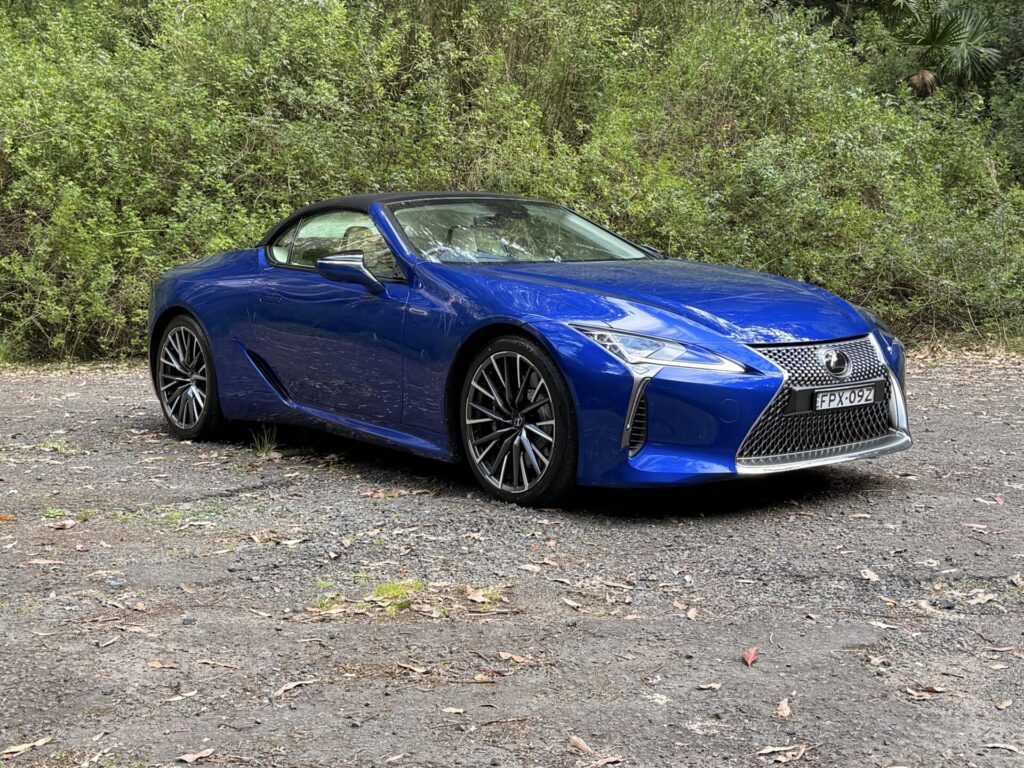
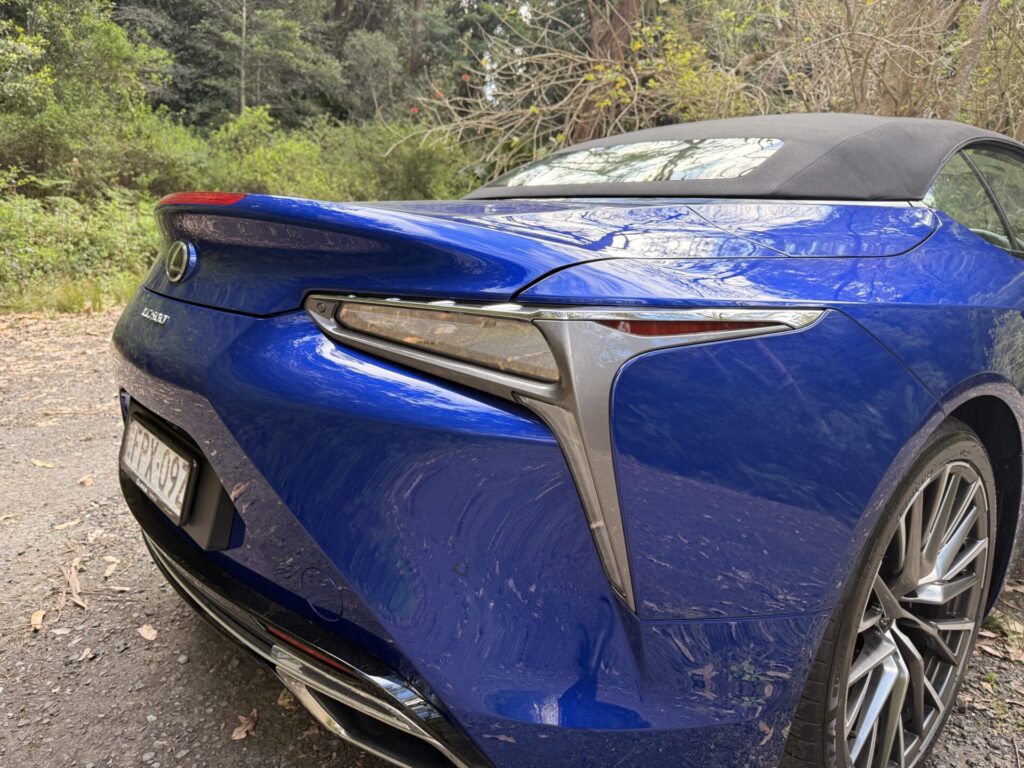
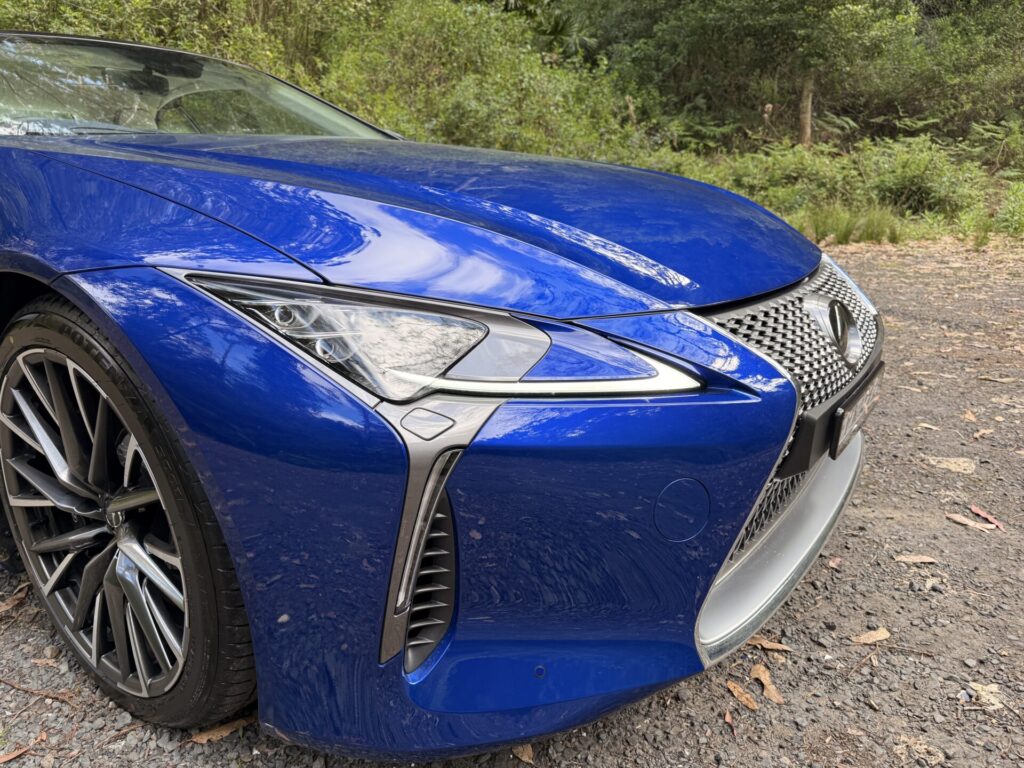
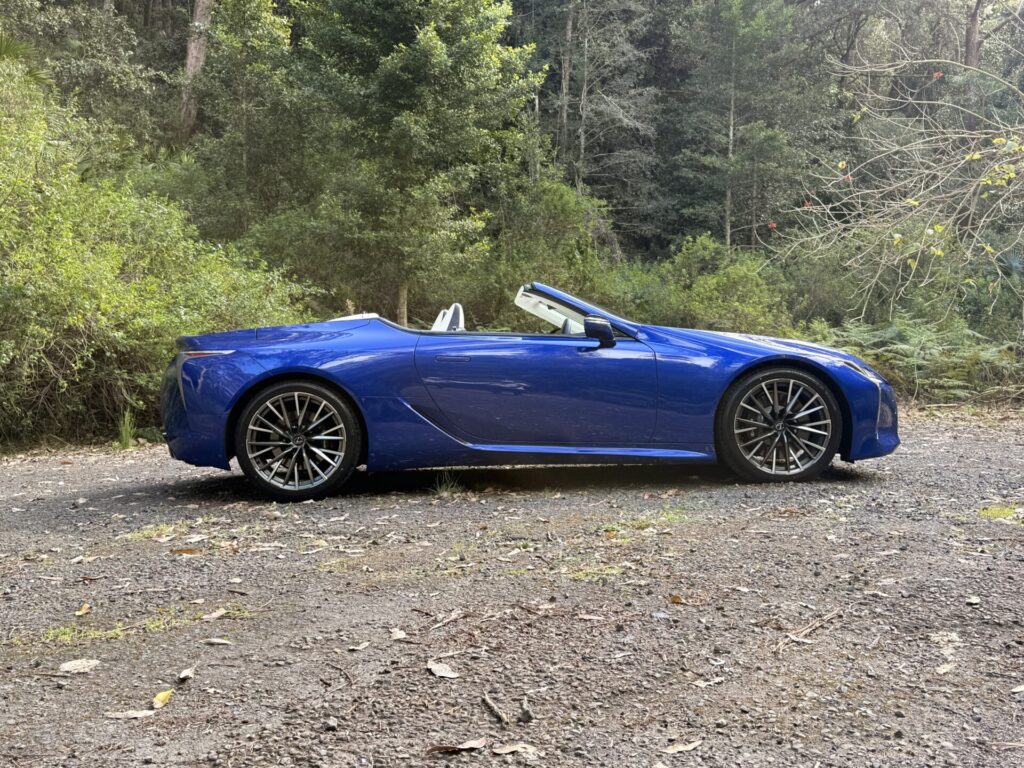
What else can I say about the way this car looks?
Well, it’s the convertible, so I have a couple of notes that don’t apply to the coupe. The roof looks (and feels) tight as a drum and works with the lines of the car, almost like they designed it that way from the get-go. From some angles you’d be hard-pressed to pick if it’s the drop-top. It remains gorgeous in a work-of-art way years after its launch and Lexus has barely touched it. I’d call that a win.
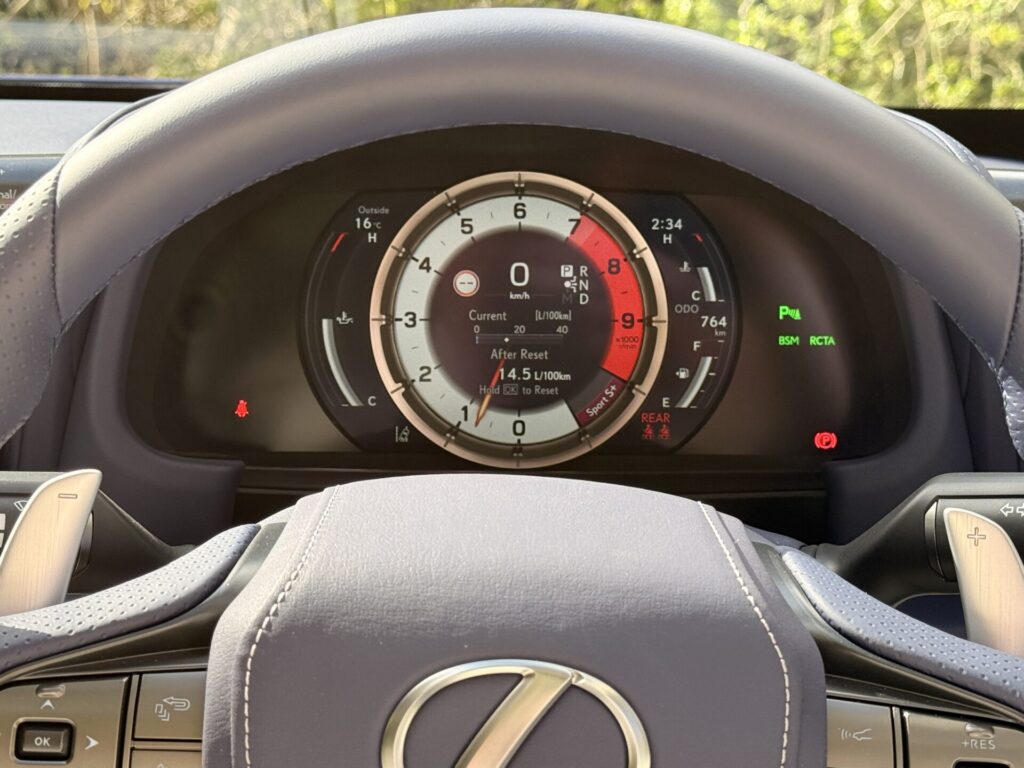


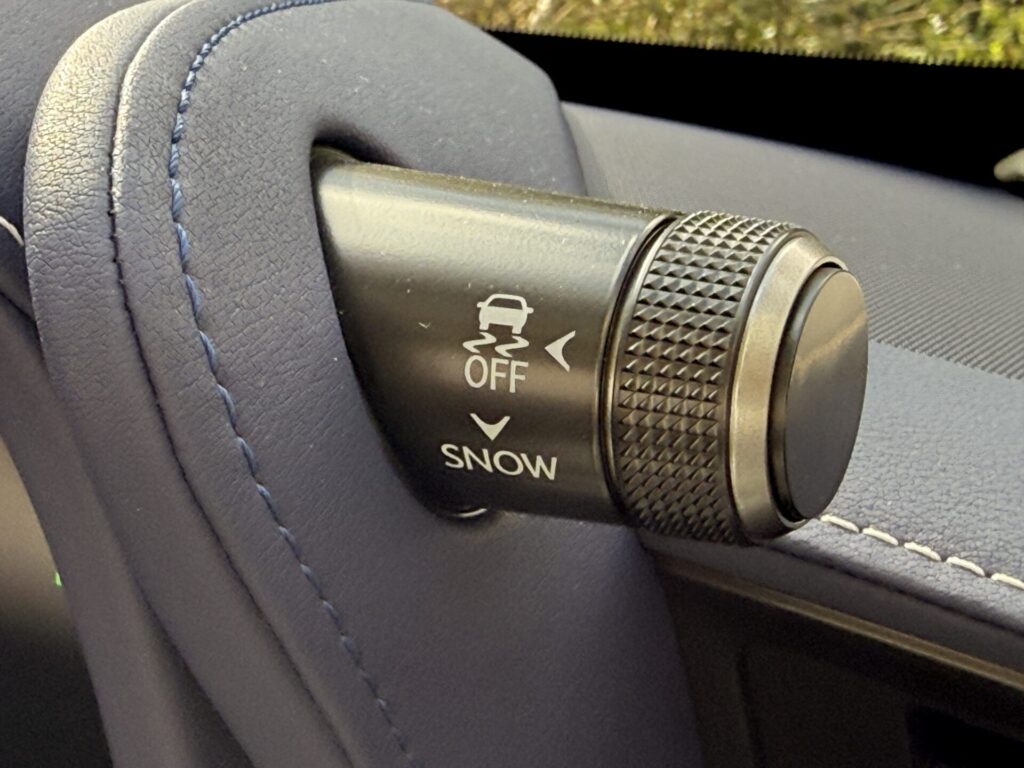
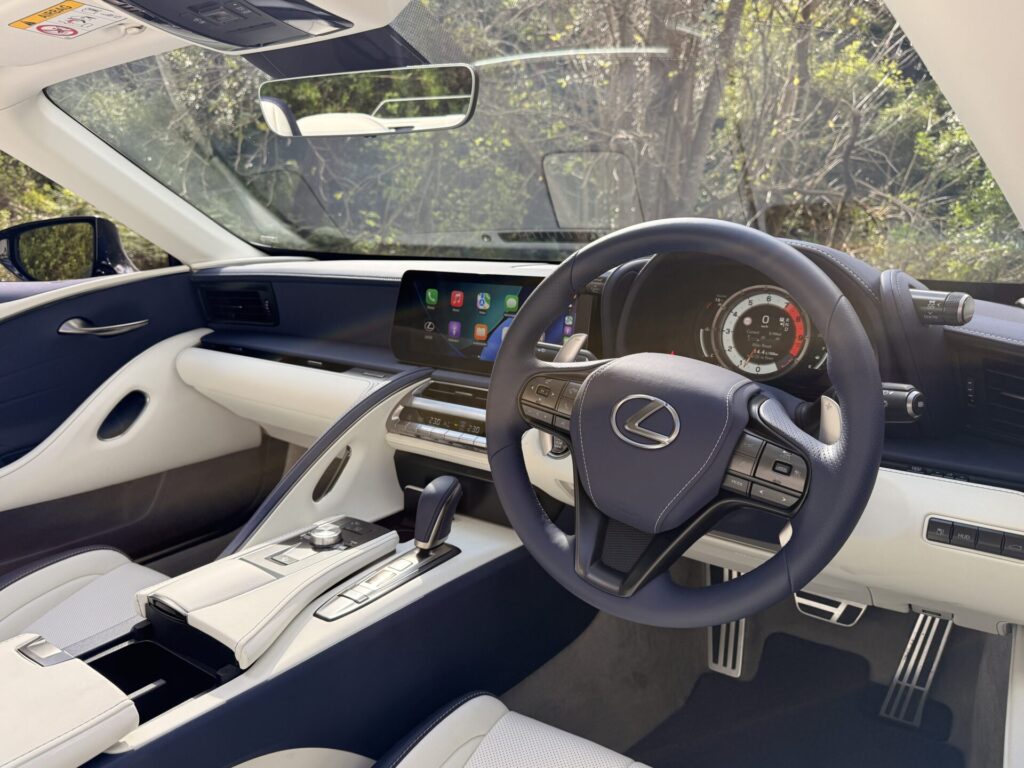
Inside it’s, again, as pretty as ever. It’s a bit spaceship-ey, with the heavy cowling over the digital dash topped with two little ear things, one to control the lights and the other for the drive mode selection.
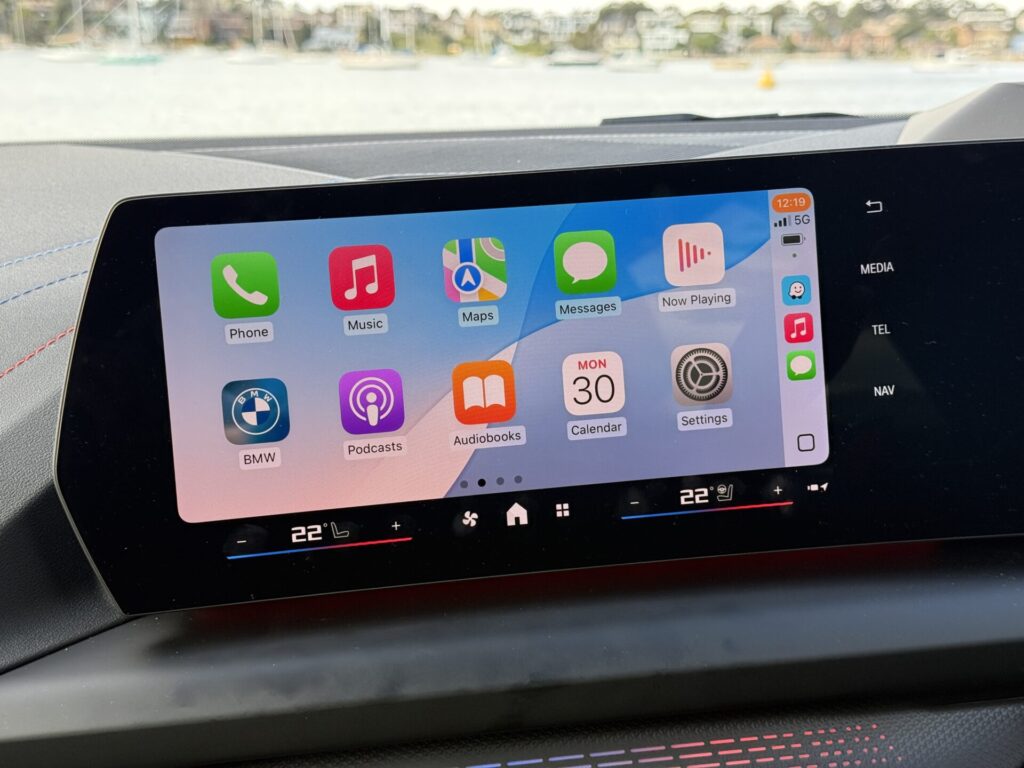
The new screen has been integrated really nicely – the old version had a big screen almost as part of the dash structure whereas this new, larger screen rests on the shelf created by the dash. It took me a while to realise it had changed, so again, calling that a win.
Slipping into the front seats – rather easier with the roof off, it all feels rather lovely. The leather is gorgeous, everything you touch is the real thing – leather, real metal, plastic that has been properly finished. The shift paddles are magnesium as is somethi of the switchgear. And if it isn’t, it looks like it.
The horrible touchpad that controlled the old screen is gone, cleaning up the centre console and hoofing that 1990s laptop feel.
This white and blue interior sounded terrible on paper but in person and over the exterior colour, worked a treat. Blue jeans will probably ruin it, so they’re your poison, maybe skip them or it.
Chassis
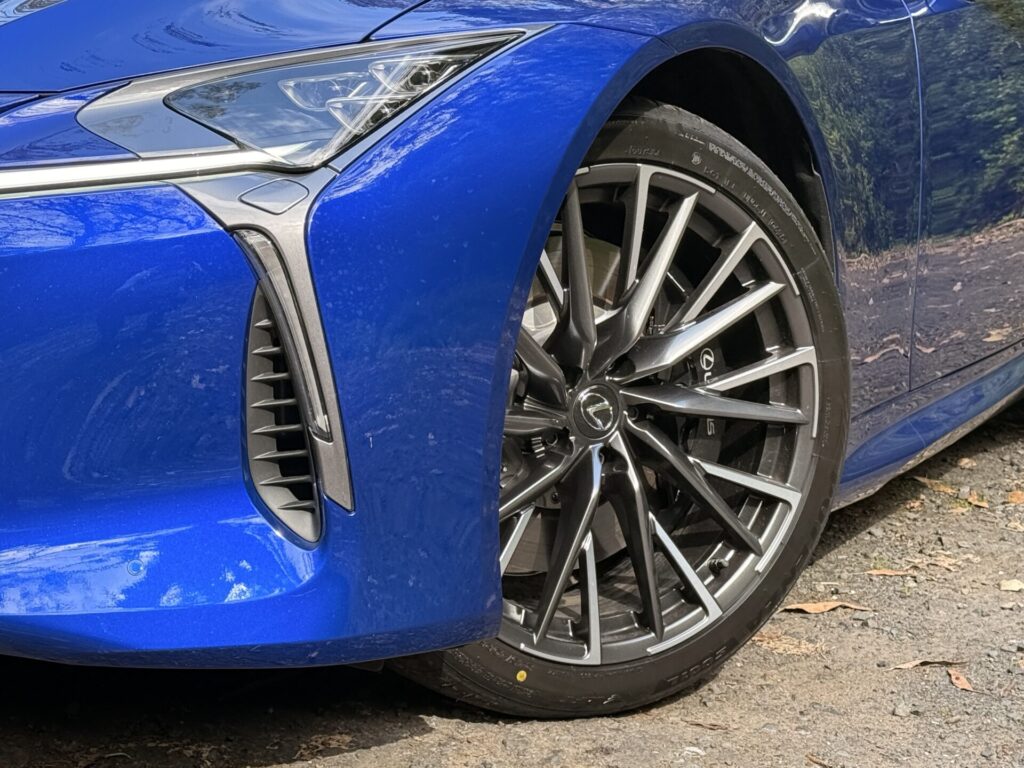
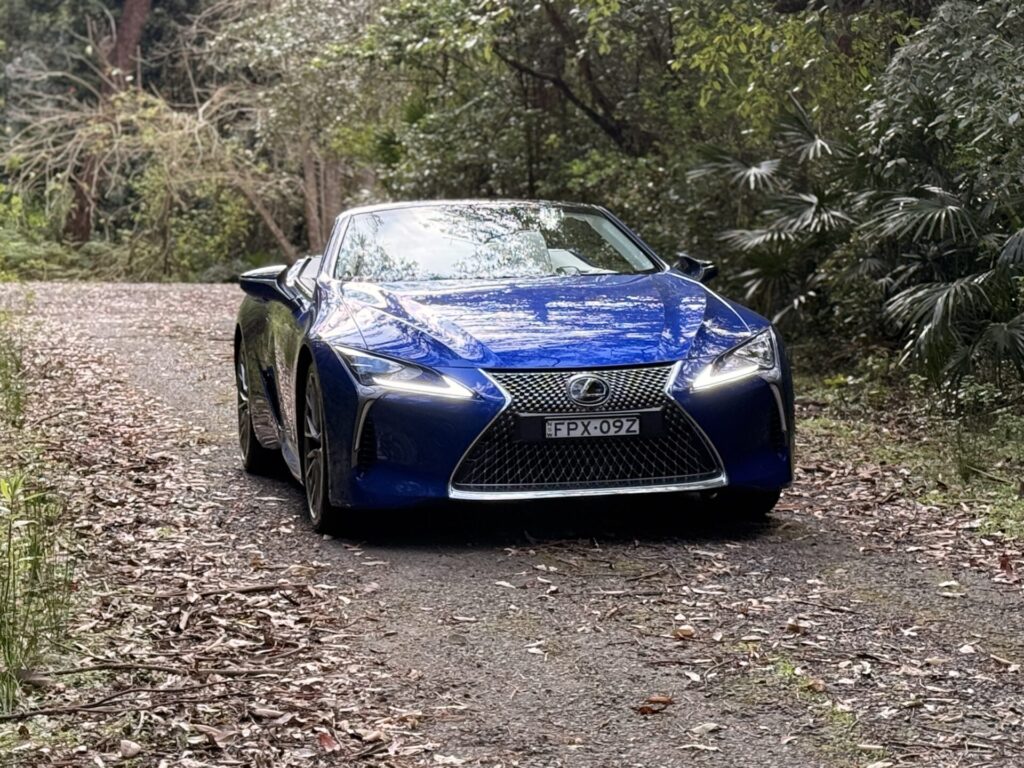
The LC is its own thing, almost like a (more) affordable LFA. Up front you have active sports dampers to go with the multi-link front end but no word on the rear dampers. It’s multi-link at the rear too.
Braking is by giant steel brakes measuring 400mm at the front and 359mm at the rear. The 21-inch wheels are wrapped in Bridgestone Potenzas (which were remarkably quiet) and measure 245/40 at the front and 275/35 at the back. They’re big.
Despite the ground-up design, it weighs over 2100kg. It’s bigger than it looks at 4.77m and even has rear seats. Which are little more than small shelves to go with the tiny 182-litre boot.
Drivetrain
Power: 351kW
Torque: 540Nm
Ten-speed automatic
The first time I drove this, I wasn’t expecting the engine to be as important to the experience. Lexus’s 5.0-litre V8 was familiar from the IS F, GS F and RC F (all resting in peace) and was developed by the absolute geniuses at Yamaha.
Known as the 2UR-GSE, it’s an all-alloy 90-degree V8 with 32-valves and all the usual cams and valve timing. It develops 351kW at 7100rpm and 540Nm at 4800rpm.
Fitted to the back of the engine is the one thing I don’t much like about the LC, the ten-speed AGA0E automatic. There are waaaay too many gears and they don’t result in a spectacular fuel figure, with the combined cycle hitting 12.7L/100km and urban a whopping 19.6L/100km. Probably would have been the same with an eight-speed, just quietly.
Driving
The LC500 is not an affordable LFA, just to confuse you. It certainly has the visual drama and a very appealing engine (sadly not a screaming V10) but it’s far more a sporting-adjacent coupe rather than a sports coupe.
That’s not to damn it with faint praise, but it’s not here to ruffle any German feathers. Lexus is smart enough to let them get on with it (or not, as the case may be). The LC coupe is certainly a tidy handler and good fun but it’s not going to snatch your breath away on a track outing.
Moving to the convertible, it’s even more obvious this is more Rodeo Drive than the Stelvio Pass. Fun on both, but for entirely different reasons.
I’m not really a convertible guy. I love the MX-5 and Lotus Elise but not because they’re convertibles. I burn quicker than a slug on a hotplate, so dropping the top impractical for me. I really have to want it.
I genuinely enjoy driving the LC500 with the top down. The gentle hum of the V8, the directness of the steering, show me a nicely twisting, even challenging road, and I’m there. In long sleeves and in a hat. Switching the Lexus up to it’s most aggressive level doesn’t do a whole lot to the chassis – it’s pretty nice whichever mode you’re in – but gives you a bit more snap and bark in the throttle and exhaust, which is most fun on the downshift.
All the while it grips hard while maintaining serenity. You won’t be chasing big tail-out moments in the LC, it just doesn’t seem right. What it does really well is brake cleanly, turn-in crisply belying its weight and then accelerate briskly and smoothly out of the corner. Thread a few together and it’s just lovely.
I twice took it down my favourite road with the roof off, once on a cool afternoon and another late in the evening. It’s an easy car to get to where you want to go and then punch it, listening to the V8 and enjoying the way this car goes about its business.
And I did that partly because this is probably my last drive of an LC500.
Redline Recommendation
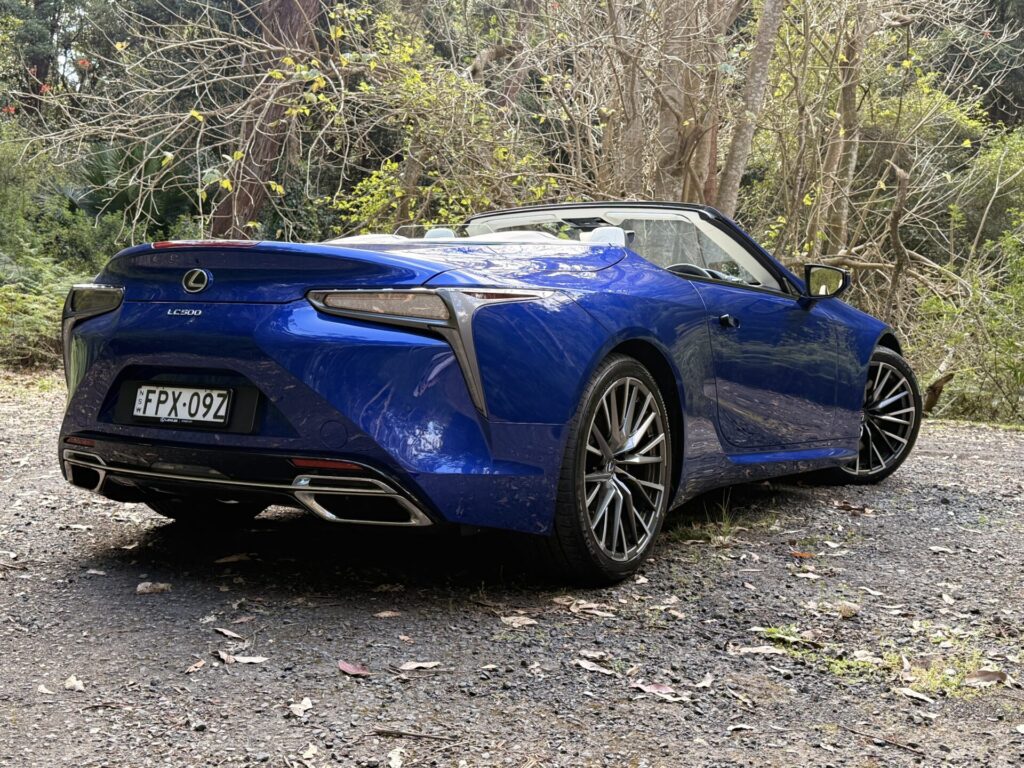
I get sentimental about these things. This car has been around for the better part of a decade but hasn’t aged at all. It still looks the absolute business and I wonder if when we’re all dead and gone these things will sit in museums the world over on display plinths.
The LC500 says a lot about what a car company can do when handed a healthy cheque by the board to go and build a statement. Hardly anybody was doing cars like this a decade ago, at least not outside of motor shows or Gran Turismo.
And no matter how long that LC500 sits idle in these imaginary museum positions, it will start on the button every time.

Leave a Reply