
California. California T. Portofino. Roma. Amalfi.
Step by step, Ferrari’s entry-level sports car has gotten better, faster, prettier and more Ferrari. The California’s critics didn’t like much about it, calling it too soft to drive and too soft to look at.
The Cali’s birth was unfortunately-timed – the car industry was in the early days of a folding hardtop craze that remains a mystery to me. There has been persistent talk that the California was originally supposed to be a Maserati but I can’t find anything that confirms that beyond reasonable doubt. It might be true. It might not be.
Later came the California T with a harder edge, but the critics persisted. Still too soft, still not Maranello enough. It’s an ahistorical argument, of course, born of a generation that only really knew front-engined V12s and mid-mounted V8s and V6s, perhaps with a lingering mid-mounted flat-12 vibe.
At least that’s how I try and convince myself that people can’t possibly be that ignorant.
The Portofino followed, but only some of the criticisms faded away. Enough of them that the name doesn’t bring out the uneducated arm of the fanatics in hives, anyway. Then came the Roma, with its new design language and the polarising front end that came with it.
Most of the criticism had finally melted away, leaving us with just the “too soft” complaint, something that had never really occurred to me. The Roma was fast, it was fun and rather stupidly, I really liked the name.
And after not very long came the Amalfi. Heading back to the coast, south of Portofino and west of Rome, Amalfi is synonymous with Italian Riviera finery. I’m not sure much links the car to the place, but everyone’s heard of it, right?
Words: Peter Anderson
Images: Blake Currall
How much is a Ferrari Amalfi and what do I get?
Ferrari Amalfi: $503,261 + ORC
Price as tested: $644,566
So, yeah, the entry-level Ferrari starts at a lazy half-million in Australia but that still won’t buy you an apartment in Sydney where you won’t wake up with a knife to your throat, so I can’t make that tired old comparison.
A reminder: this is a low-volume sports car with a reasonably limited production run in that there are only so many people who can afford them and Ferrari has a notional cap on overall production.
It’s also got some extraordinary engineering in it that can’t be amortised over a million hatchbacks and SUVs.
Anyway, your entry into Ferrari ownership nets you a 3.9-litre twin-turbo V8-powered 2+ coupe with 20-inch wheels, carbon-ceramic brakes, LED headlights, dual-zone climate control, a 15.6-inch digital dashboard, a 10.25-inch media screen keyless entry and start, power bootlid, leather interior (and not that hard leather everyone else has), heated front seats, wireless phone charger, DAB+ digital radio, wireless Apple CarPlay and Android Auto.
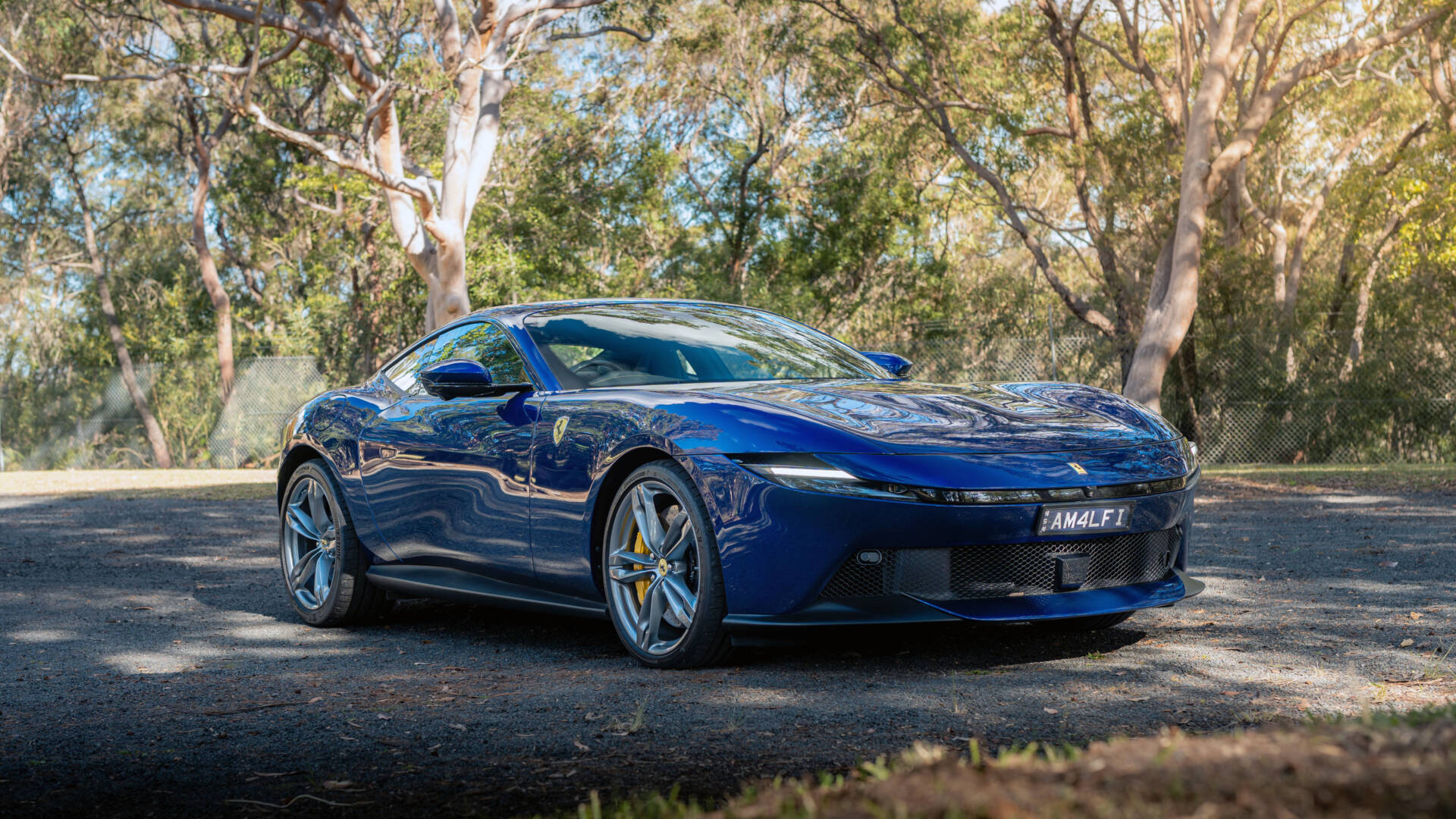
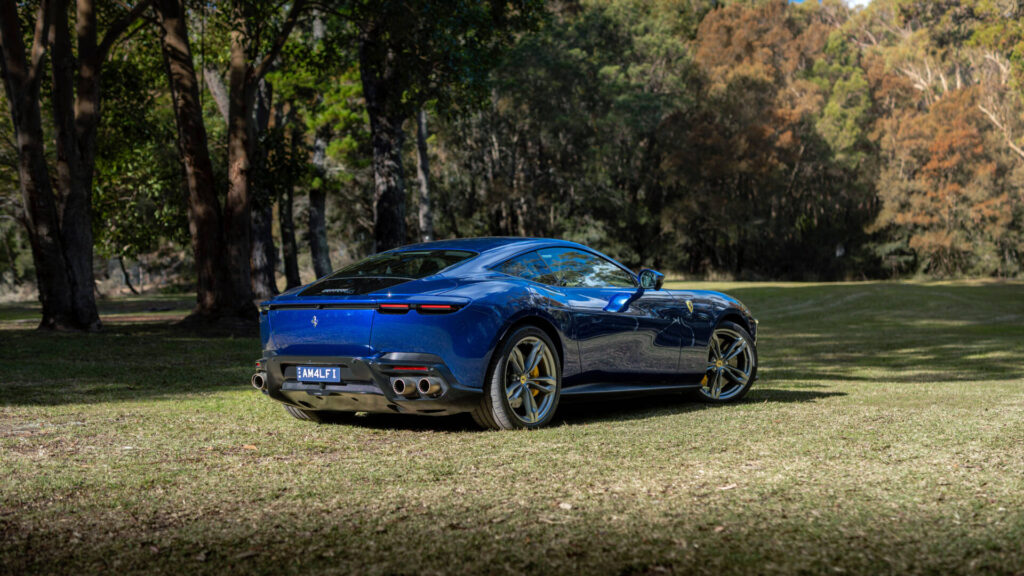
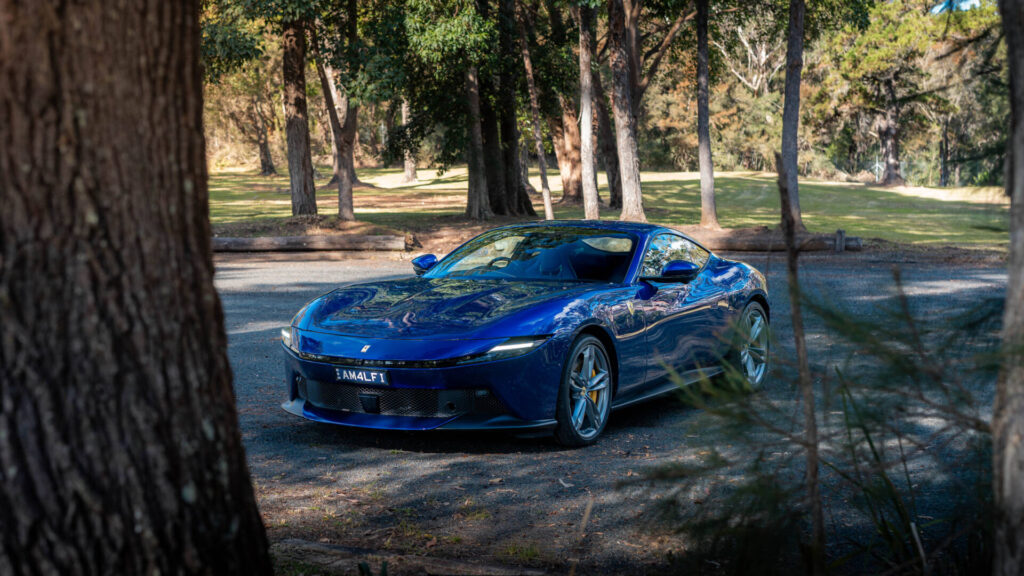
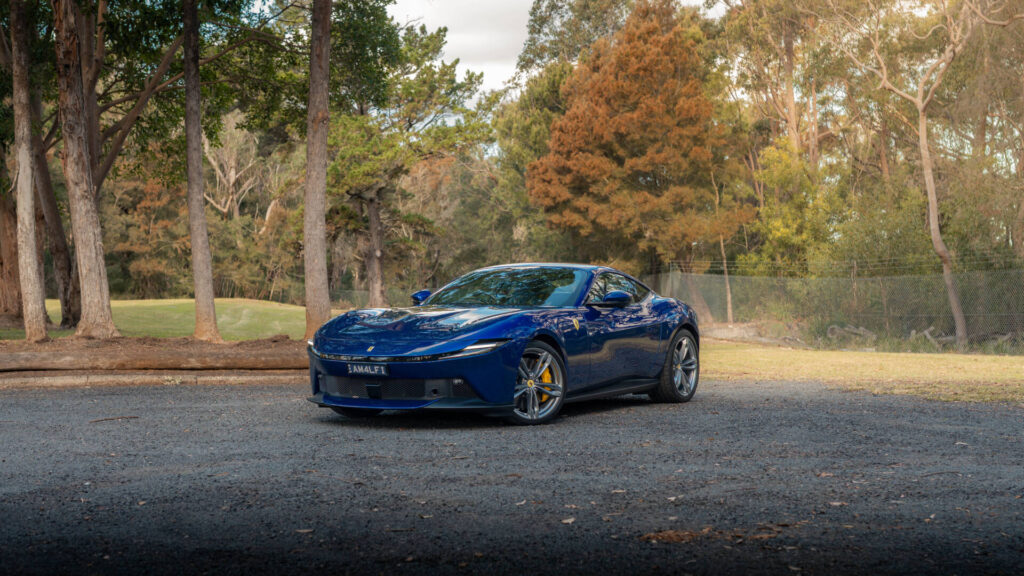
Adding to the base price is this car’s absolutely gorgeous Blu Vietri with an arresting combination of Azzurro Santorini Blue and Giallo Ravello (yellow) on the inside. Ferrari Australia has traditionally been adventurous with its Tailor Made interior specifications and this one doesn’t disappoint. The interior colour combo is not for me, but gives you an idea of what you can get up to while speccing out your machine.
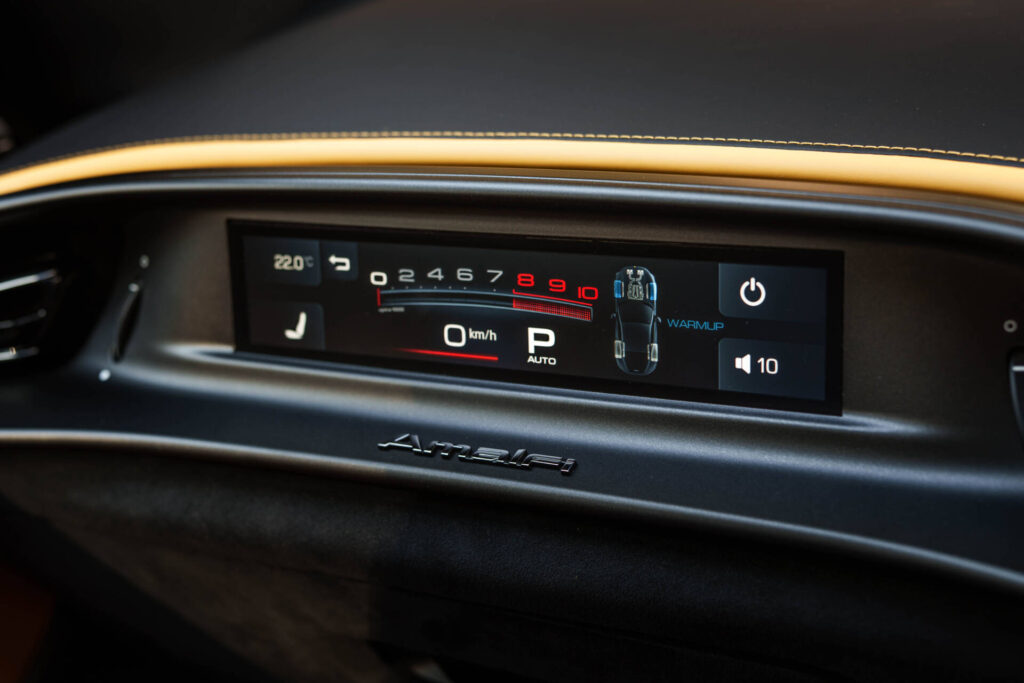
Also fitted was the pasenger-side information screen that sadly does not mirror Apple CarPlay (or I assume Android Auto) but is quite fun for nervous passengers if you leave it on the revs and speed screen.
Safety
For a long time, we were told we couldn’t have safety gear in sports cars but thankfully, we’re seeing it more and more. The cabin has four airbags, forward AEB, blind spot monitoring, parking sensors, reversing camera and various lane-keep systems.
As you might expect, the stability and traction controls are both very clever and switchable.
You can quickly access the ADAS menu to turn off the fatigue/distraction monitoring too.
Service and warranty
A few years ago, Ferrari astonished us all by introducing a three-year warranty and seven years free servicing. So that’s that sorted then.
Look and feel
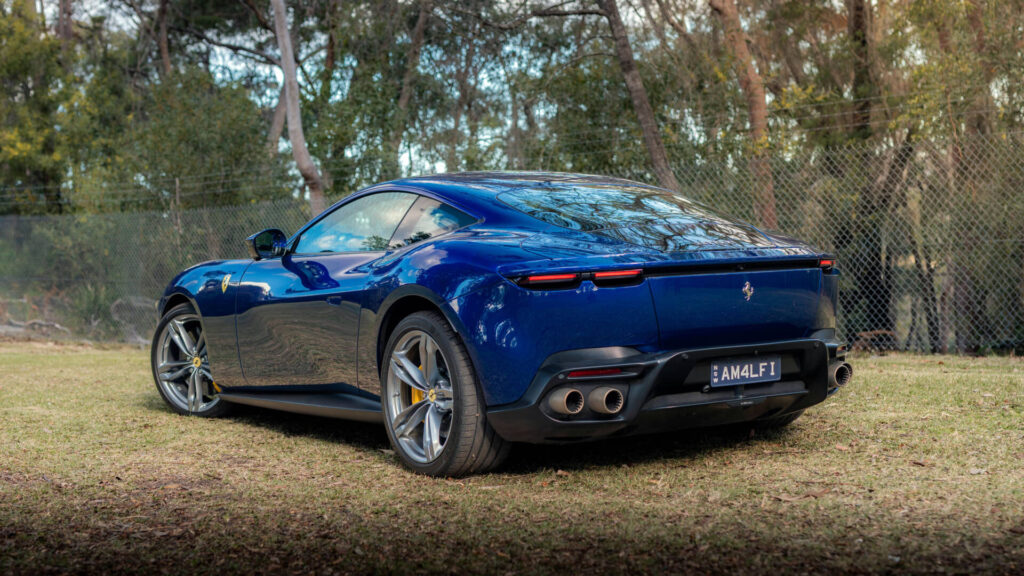
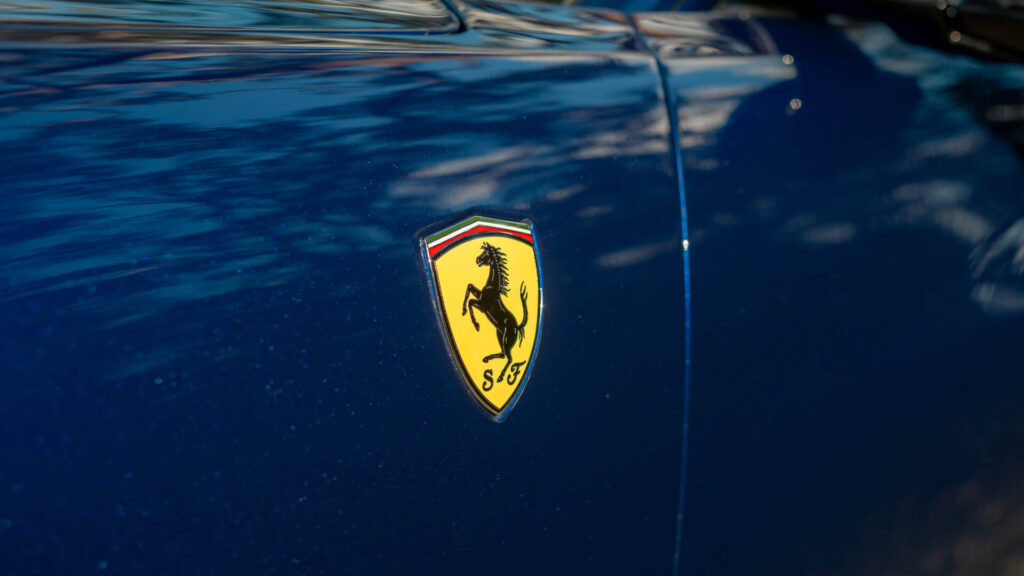
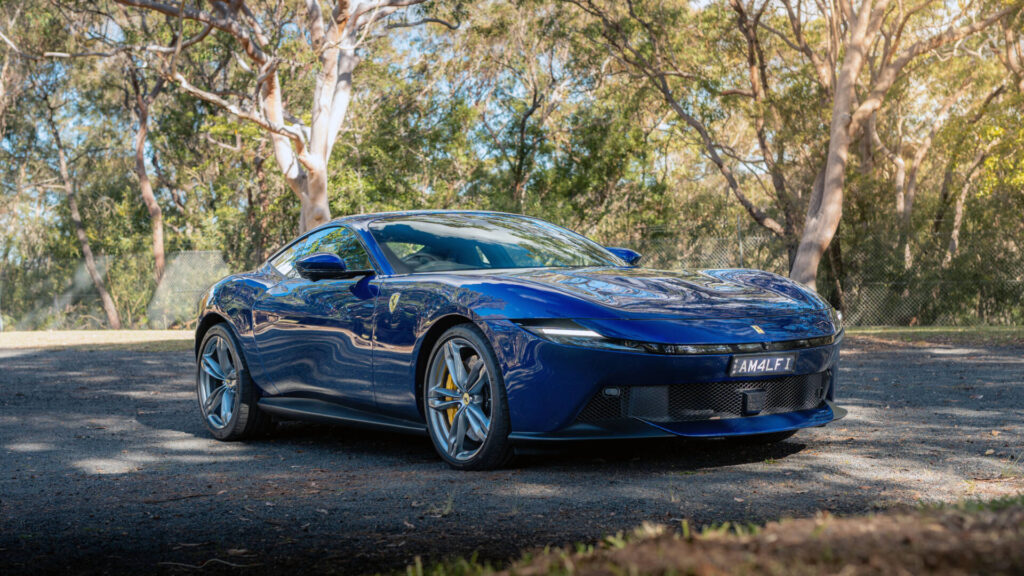
One of my hot takes is that I actually quite liked the front end of the Roma. It was certainly something different and took the visual language in a new direction, away from the long, swept-back headlights so favoured of Flavio Manzone’s team for almost a decade.
It didn’t please a lot of people, however, so the Amalfi’s new front end is very clean and has made the haters happier. Well, some of them, anyway. It’s definitely sleek and the larger black grille better accommodates and hides the safety systems’ little black boxes and sensors. The new headlights do look better than the Roma’s which had the unfortunate timing to look like a Vantage’s (and vice versa, of course)
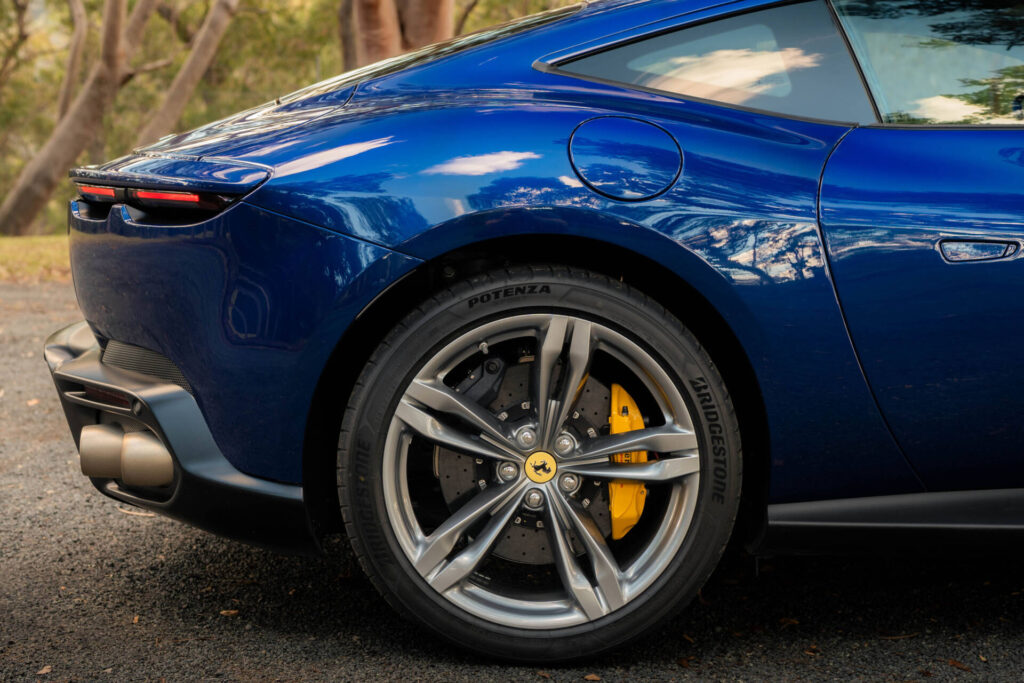
It’s a gorgeous, flowing design although I’m still a little bothered by the way the side glasshouse comes together a little awkwardly at the haunches. That’s the worst thing I can say about it.
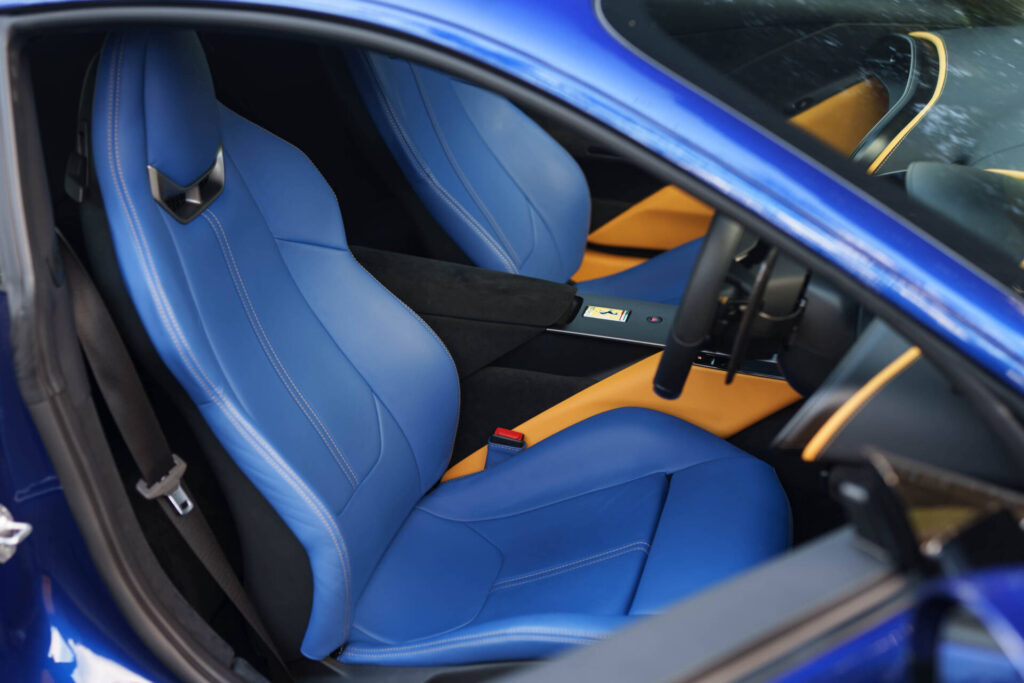
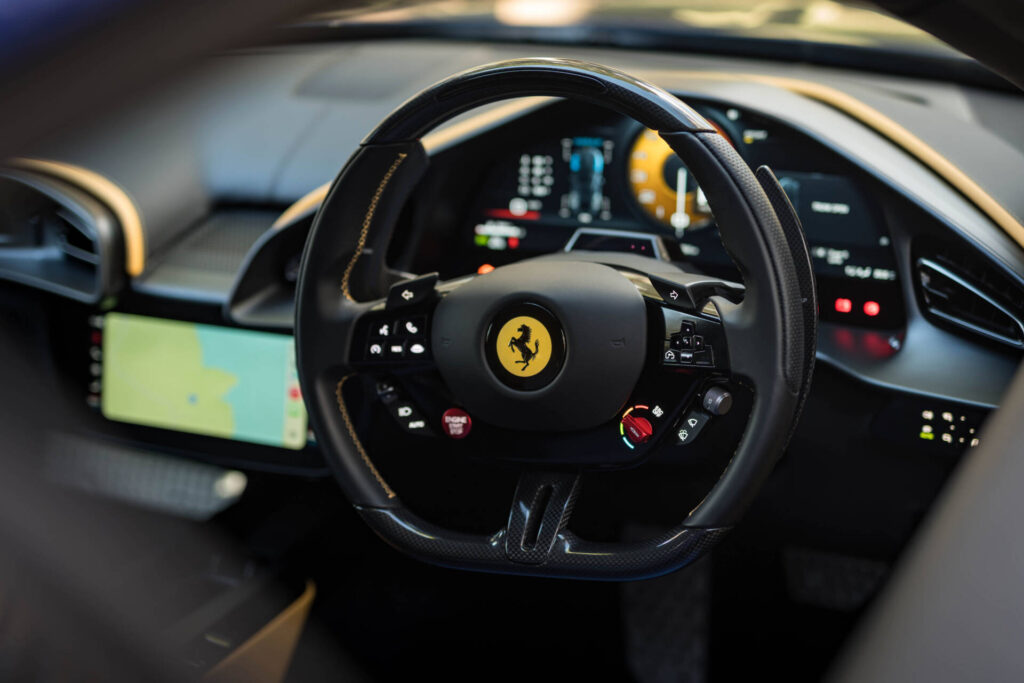
This interior is certainly full of choices but, being a Ferrari, this is not the way you have to have it. The way it was described to me I thought, “Oh, no, it’s a football strip.”
Now. The colours are certainly not to my taste but hoo-boy is this a nice cabin. Like really genuinely nice. It feels really beautifully put together in a way that Ferrari has not always managed. No squeaks or any of that nonsense. The colours really show you what you can do when you go to work with your dealer.
Also vastly improved are the ergonomics. While I didn’t find the Roma’s soft buttons on the steering wheel to be worse than anything anyone else has dreamt up, real buttons are definitely my preference. Their return here is laudable.
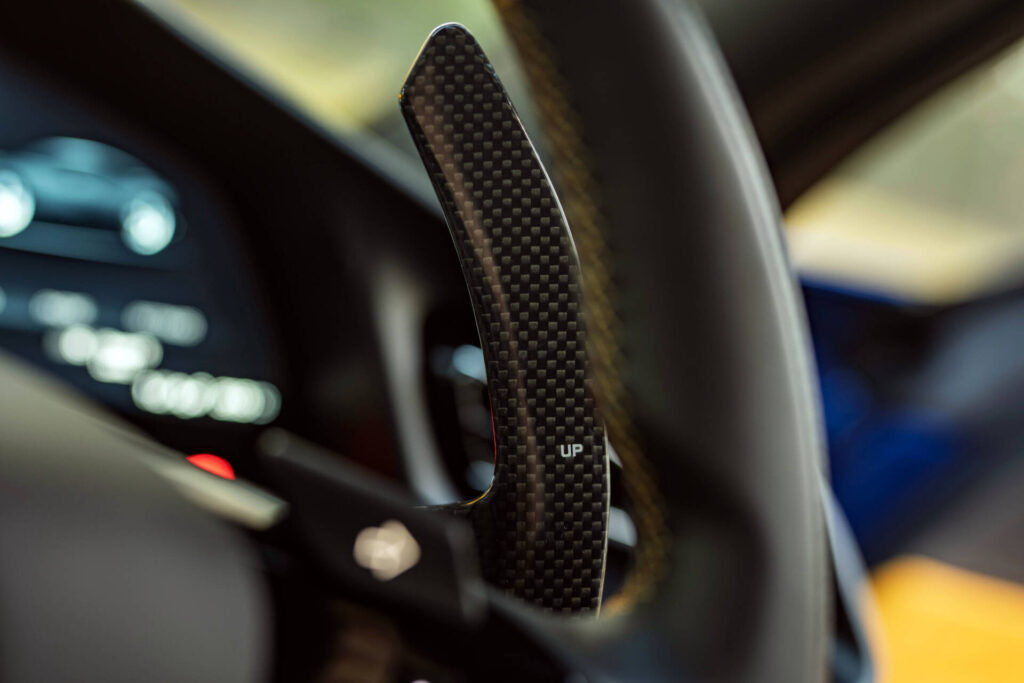
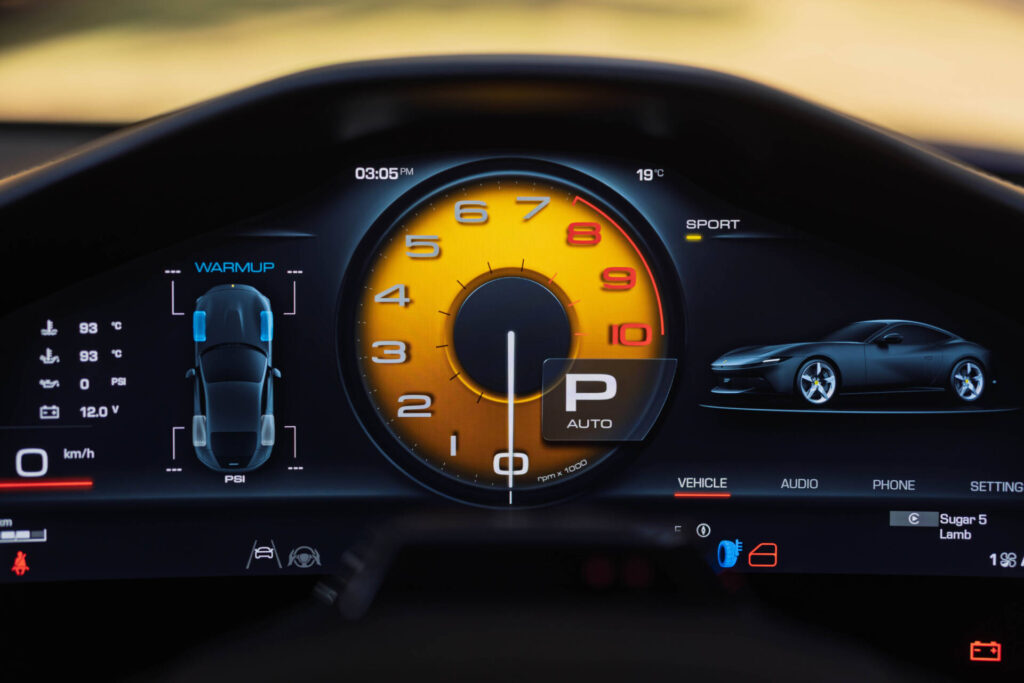
The steering wheel is the perfect size – I love a big wheel because you can see the (excellent) digital dashboard and you can also drive this car normally and sensibly. I really like the way your hands sit on it and how the paddles are super-easy to operate.
I also like how there’s a separate screen down in the centre for the media system rather than the clunky dashboard panel favoured on some other Ferraris. While that older solution freed up space and made the cabin a bit more focussed, it made navigating CarPlay and Android Auto a colossal pain.
This car also had the optional third screen in front of the passenger, which offers some seat controls, stereo controls and a secondary dashboard display, which I feel would be hugely useful if ever one were to tarmac rally this car. Other than that, a bit of an oddball thing, but Ferrari customers clearly like because over the years, Ferrari has added more features to it.
Driveline
| Engine | 3.9-litre twin-turbo V8 (F154) |
| Power | 471kW @ 7500rpm |
| Torque | 760Nm @ 3000-5750rpm |
| Transmission | 8-speed twin-clutch |
| Drive | Rear-wheel drive |
| 0-100km/h | 3.3 seconds |
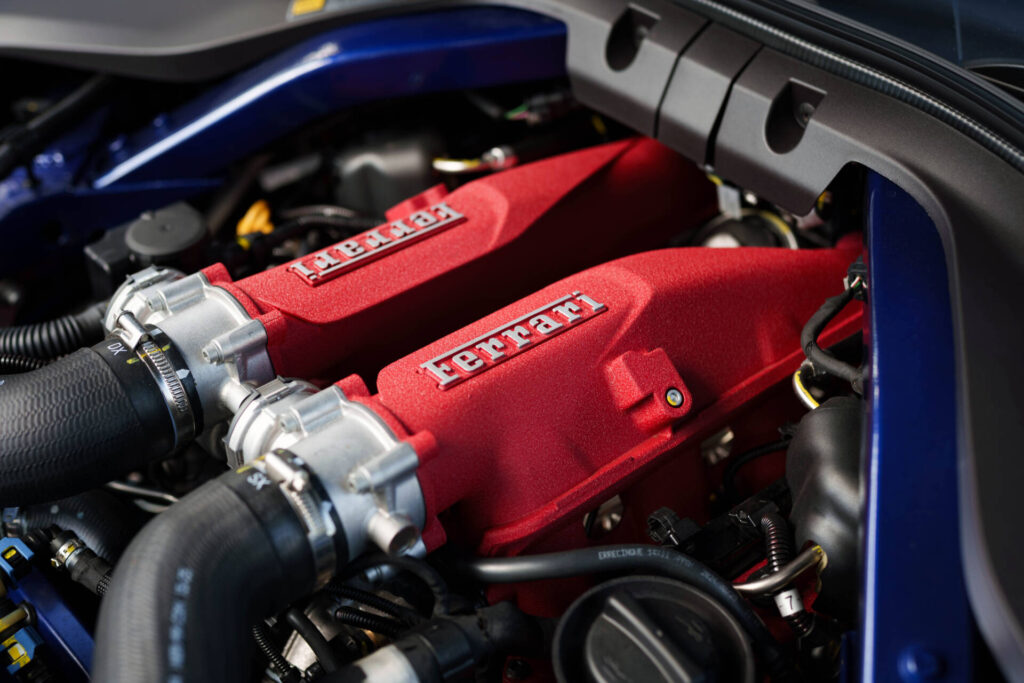
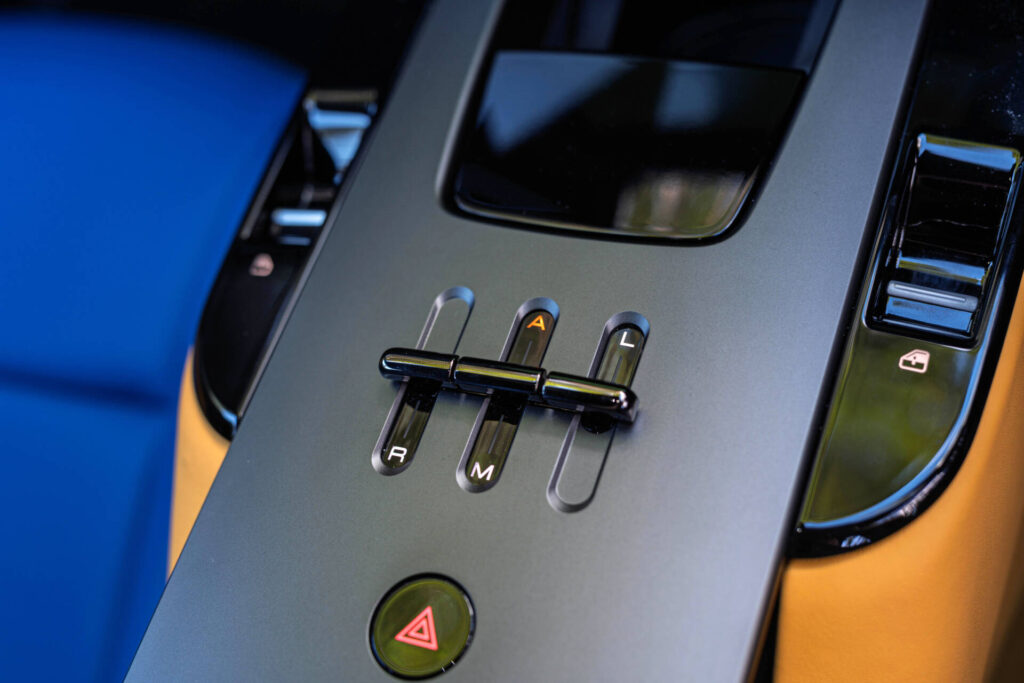
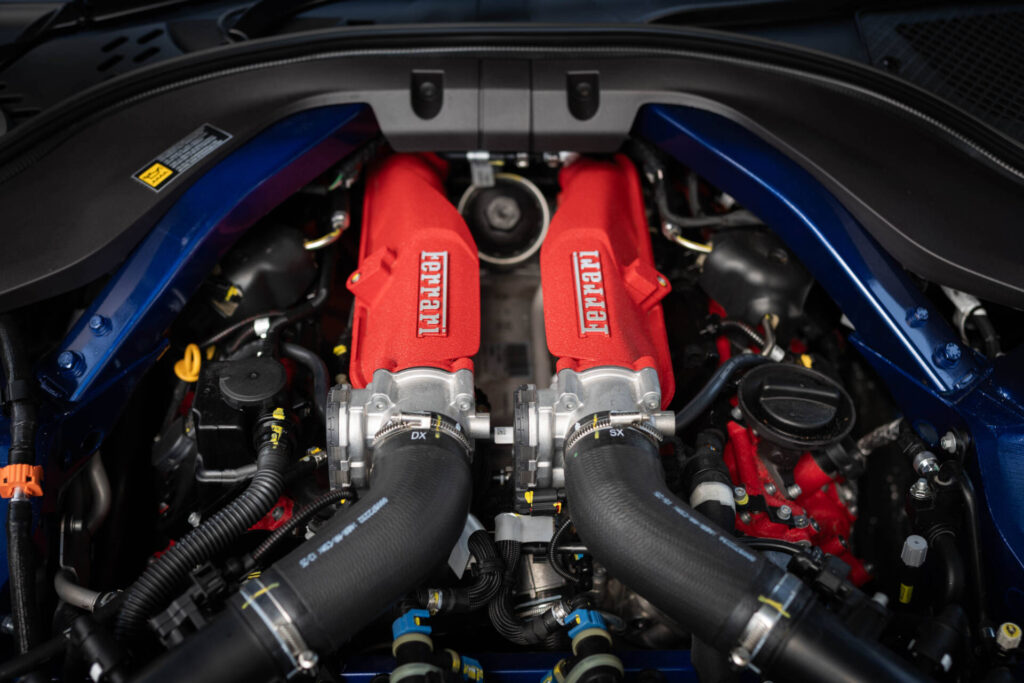
Ferrari’s increasingly brilliant and award-winning F154 returns for duty in the Amalfi, now with 471kW (640PS/631bhp) at a lofty 7500rpm, just 100rpm short of the raised 7600rpm redline.
The engine now has more precise calibration and control of the two turbos, which spin to a heady 171,000rpm. There are now pressure sensors on each cylinder bank which Ferrari says improves throttle response, which was already good for a turbo.
Top-end weight is down by 1.3kg with new camshafts. Some slicing and dicing of excess bits of the engine block drops another kilo. As with the Roma, it’s front mid-mounted, with the front half of the engine bay taken up with cooling and induction.
The SF90’s eight-speed – also seen in the Roma and Purosangue – has a dry sump and some new clever torque management to smooth out the drive. A transaxle setup, you’ll find the gearbox under the boot floor, which does explain why the boot is so small.
And to make things a bit nicer to listen to, the exhaust design has changed to get more sound inside the cabin while passing regulations for drive-by noise. Still sounds great, obviously, but it’s not going to challenge the AMG kiddies anytime soon for obnoxious volume and bangs.
Chassis
| Tyres | Front 245/35 R20 J8.0 Rear 285/35 R20 J10.0 |
| Brakes | Front 390 x 223 x 34 mm Rear 360 x 233 x 32 mm |
| Length | 4660mm |
| Width | 1974mm |
| Height | 1301mm |
| Wheelbase | 2670mm |
| Weight (dry) | 1470kg |
| Systems | EPS, VDC, ABS with EBD, F1-TCS, E-Diff3, SSC 6.1, FDE 2.0, SCM-E Frs |
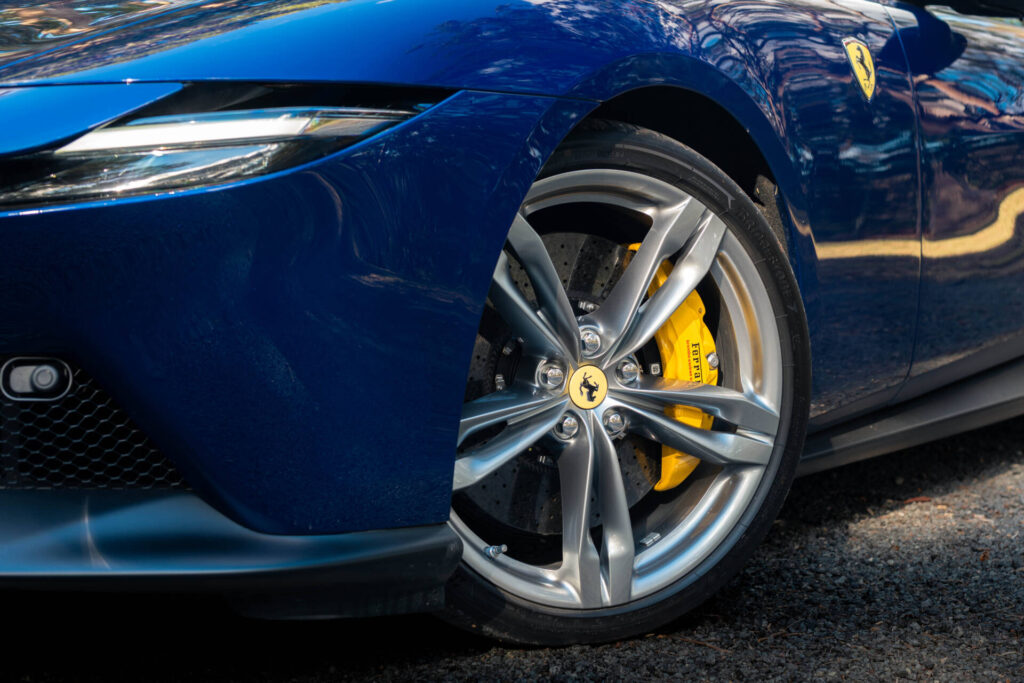
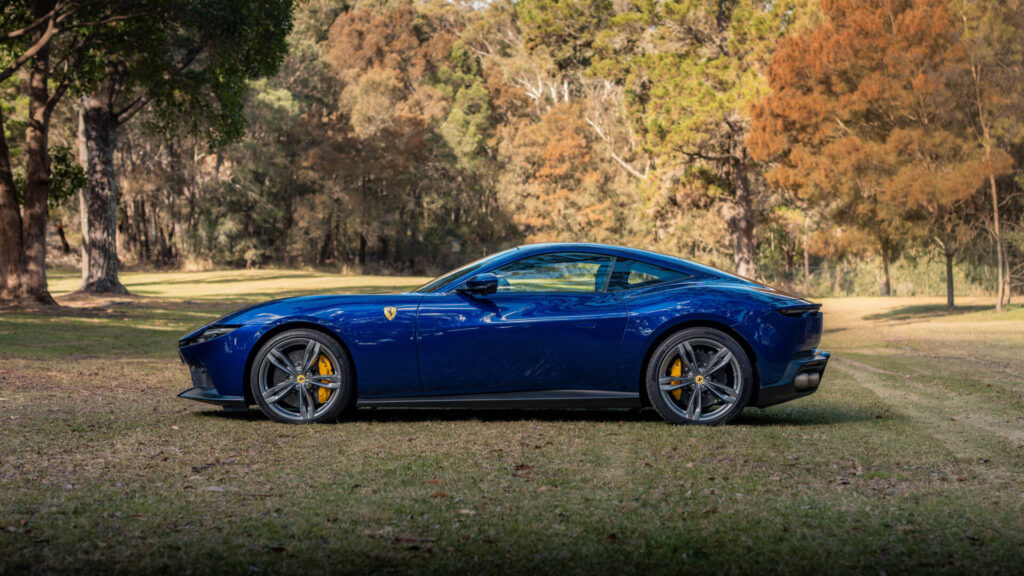
The Amalfi’s chassis is much the same as the Roma’s, but with a bunch of detailed changes. The 20-inch wheels (these are the standard ones and they’re gorgeous) are wrapped in 245s at the front and 285s at the rear. Spoiler alert, the 285s aren’t quite enough…
Like an Audi RS, you’ll get tyres from either Goodyear, Pirelli or Bridgestone, all co-developed with the tyre manufacturers in question.
Carbon ceramic brakes measure a whopping 390mm at the front and 360 at the rear, with Brembo calipers. The fronts are six-piston units while the rear make do with four. It’s plenty.
Brake control is by Ferrari’s ABS Evo system which is said to make faster decisions about the pressure applied to each wheel under heavy braking. Ferrari also says straight-line braking is improved as well as in slippery conditions. The system is shared with the 12 Cilindri, 296 GTB and the Purosangue.
Suspension is by double wishbones at the front and a multi-link setup at the rear. As with the Amalfi, adaptive damping comes courtesy of Magneride dampers, which are the traditional oil-based dampers that react to an electric current passed through the fluid to firm up the damping.
I decried the disappearance of the bumpy road button, but was assuaged by the fact you can press the manettino dial to activate it. That dial remains one of my favourite ways to change drive modes in any car, such is its simplicity and general race-car drama. And it’s made of aluminium.
Central to this kind of car is how the electronics work with you. Ferrari’s acronym package includes SSC, or side-slip control. Now in version 6.1 (I have no idea which car had version 1), it pulls in data from steering, wheels, diff and a whole host of other things to keep things on the road.
This includes the hilariously-titled Grip Estimation System which Ferrari says is ten percent faster and means more grip – again – in low traction situations. You could wave this away, as others do, as being for the kinds of people who buy the Amalfi, but this system is on everything Ferrari sells for the road, so calm down.
The sleek shape has plenty of subtle aero devices and that includes the pop-up rear spoiler that deploys when required. Ferrari says you’ll get up to 110kg of downforce at 250km/h, which is cheering because at that speed, you’ll need it.
Naturally there’s a limited-slip electronically controlled differential between the rear wheels, along with the gearbox, for a 50:50 weight distribution.
Driving
My memories of the Roma are good ones. It was very quick in a straight line with the kind of brutality we’d come to expect from twin-turbo V8s but also the adjustability that only Ferrari seems to be able to deliver. Nearly 500kW from 3.9-litres is an incredible achievement, along with an equally impressive 760Nm, there’s a lot to tame.
And the Amalfi does it as though it’s running a 2.0-litre TFSI when you’re just pottering about. Sure, you know it’s got a bit more grunt than that, but it’s so flexible and simple and easy to live with.
The same goes for the way it steers and rides. In comfort mode, one step above wet, it goes about its business in a straightforward way not even a Jaguar F-Type four-cylinder could manage.
Despite rolling on those gigantic 20s, the Magneride suspension delivers a near faultless ride at normal speeds. Not once did I flinch or grind my teeth, which is more of a compliment than you might imagine – this is a half million dollar car that costs an enormous amount to fix if something breaks.
Nothing terrible Sydney roads could throw at it seemed to upset it, even the horrible concrete roads dotted around the place.
Even so, I spent most of my time in sport mode, as it dialled up the throttle response nicely without ruining the ride. It doesn’t waft – that would be silly, everyone would get mad – but the control is hugely well calibrated. There is a lot of tyre rumble, as you might expect with all that rubber, but it’s also to do with a no-doubt conscious decision to ensure you can hear everything.
Needless to say, if you’re not worried about resale and you used this car as a daily – a problem almost nobody reading this will have – you’d be perfectly happy to do so. Which, when you think about it, makes a lot of sense. You pay a lot of money for a great car, so get on it. I would.
Speaking of getting on it, this car is an insane amount of fun. From its organ-crushing acceleration, the lovely, if muted, howl of the twin-turbo V8 through to its endless grip, the colossal cost matches the joyfulness.
There are cars that are nearly as quick and a lot cheaper, but they just don’t have that final five percent of crispness, that knowledge that the car underneath you has been engineered way past what you’re capable of as a driver (unless you’re one of the one percent of truly great drivers, which I am clearly not).
In Race mode, it’s delightfully loose and marvellously silly, but I didn’t spend much time in that mode because, as I said, I’m not that driver. On the road, I can’t imagine why you’d need to leave Sport mode, so that’s where I stayed.
That big steering wheel turns a rack that I regard as almost perfectly weighted. Being electric you don’t get that visceral connection to the road surface, but there’s plenty of chatter back up through the chassis that you know what’s going on.
I’ve loved the delicate lightness of Ferrari steering for well over a decade now. The engineering challenge of finding feel with electric steering is a tough one and just throwing weight at it won’t do it, especially not with all that tyre.
So Ferrari took a different route, with lightness and delicacy, with a quick rack and the front end to match. When you spend most of your time doing the good and proper work of testing the cars that most of us buy, it’s always a revelation to jump into one of these cars and feel what a darty front end can do and what all that money buys.
Ripping into corners in the Amalfi is always a joy. The car has a real sense of humour, with those incredible brakes that are unbelievably powerful but also don’t need a heck of a lot of effort even if you are hard on them. Turning the wheel, it doesn’t feel like what is really a pretty big car, with a lot of length in the front because the engine is behind the front axle line.
And with a reasonably long wheelbase, it could feel doughy, but it turns like something much smaller, almost like a hot hatch. It’s not a particularly heavy car so I don’t have to embroider this with qualifiers – it’s probably 1550kg wet, give or take, but that’s not much more than a Corolla and less than almost any BMW M2 ever made.
The steering is never too much, though, and that’s the key to this car’s broader appeal. Everything else about it is low effort meaning anyone can drive it and enjoy it. But there’s so much in this car to enjoy for people who love driving, want to drive and love a twisting road.
You do need a lot of road for this performance, though. The grip is phenomenal at the front but even in Sport mode, the tail will give you a little whip crack to remind you how much force is being fed through the car to the road.
Send the throttle to the firewall and the scenery comes at you with almost indecent rapidity. Even though you don’t have full torque until the higher gears – that particular metric is carefully metered by the various systems – the way this thing gets moving doesn’t feel like a turbocharged V8.
Coming out of corners, the power is there long before most other turbos can manage it and the further to the right you turn the manettino, the more brutal it becomes. Few cars are this exciting to drive and few turbos respond so quickly to an ankle flex.
It’s not the naturally-aspirated V12, no, but it’s so far beyond what most car companies, AMG included, can manage.
Redline Recommendation
The Ferrari Amalfi is brilliant and flatters anyone who drives it. While it’s unlikely the kind of wealth required to own an Amalfi will ever be a problem for me, it’s the first Ferrari where I thought, “Yeah, I could own this.”
It’s usable, my wife would be perfectly happy driving it because in the everyday, it’s easy. But if a crisp winter’s morning (in Sydney, which is rarely crisp or wintery these days) presented itself, I could nip out to a road I like or think I might like and have a brilliant time.
Importantly, while it’s quite pretty, it’s not flashy. The proportions are lovely, but it genuinely went unnoticed most of the time, with a few folks nodding or noticing who knew what it was. Get rid of the silly plates on the press car and it’s as much a sleeper as a long, low sports car can be.

Leave a Reply